
Drone Delivery Leaders Accelerate Plans for Large-Scale Operations
Zipline and Alphabet's Wing recently announced major capability upgrades aimed at scaling drone delivery to millions of annual flights. However, achieving these ambitious goals requires overcoming operational cost challenges, regulatory restrictions, and consumer skepticism, as highlighted by industry experts and company executives.
Two prominent players in the drone delivery sector—Zipline and Alphabet's Wing—unveiled significant capability enhancements earlier this month, positioning themselves to transform last-mile logistics. While their technological approaches differ, both share a common objective: scaling operations to reach a broader customer base.
Wing projects its drone delivery network will handle millions of deliveries by mid-2024, while Zipline aims to conduct more flights annually than most airlines by 2025.
Achieving such scale demands more than substantial investment—as Amazon's reported drone safety challenges and limited delivery activity illustrate. To deliver on the hype, drone operators must reduce operating costs by maximizing network efficiency and securing regulatory and consumer support. Otherwise, experts caution, drones may take far longer to become as ubiquitous as delivery vans.
Enhancing Density and Regulatory Flexibility to Cut Costs
In last-mile delivery, carriers strive to increase density—maximizing deliveries per route to minimize costs. For drones, which typically carry lightweight payloads, a network can create its own density by keeping the fleet in constant motion, executing pickups and deliveries as frequently as possible to sustain the business model.
"The worst thing is to have your vehicle, whether it's a drone or a truck, sitting idle," said James Campbell, professor of supply chain and analytics at the University of Missouri-St. Louis. "The way this makes the most sense is if you can get the huge scale so your drones are flying all the time. You're spreading your fixed costs for the facilities over many, many drones and many, many deliveries."
While delivery density is critical, it is only one avenue to lower operating costs, noted Eric Peck, CEO of drone logistics platform Swoop Aero, in an email. Operators that design faster drones can respond to demand more quickly, offering greater value to customers and enabling more profitable services. Increased delivery range also helps by unlocking new business lines, such as offshore maritime logistics.
Peck added that having one pilot monitor multiple aircraft would maximize returns on network investments. A McKinsey report published in January supports this view, stating that under current pilot limitations, drone delivery struggles to compete with other last-mile modes on operating costs.
The report estimates the cost of a single-package drone delivery with one person monitoring the drone at about $13.50. If a single operator manages 20 drones simultaneously, the per-delivery cost drops to around $1.80.
Drones have most to gain from efficient delivery operations
In the U.S., a waiver is required to operate multiple small drones with only one remote pilot, and operators also need certification for deliveries beyond the visual line of sight of a pilot or observer.
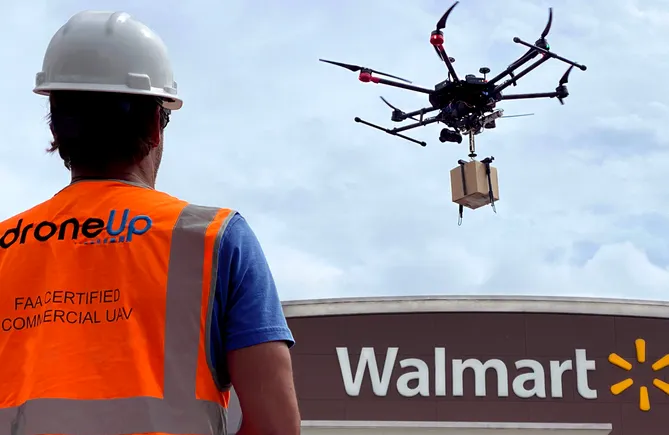
For DroneUp, which assists Walmart in its goal of 1 million deliveries a year by drone, visual line of sight restrictions have limited delivery radius to about two miles. Extending that radius would have significant upside—DroneUp COO Anthony Vittone noted that 90% of the U.S. population lives within ten miles of a Walmart.
"Every mile that I add to that [drone delivery] radius triples and sometimes even quadruples the number of homes that have access to DroneUp delivery," he said.
Consumer Acceptance and Behavioral Shifts Required
As delivery activity increases, companies must address community concerns. Vittone acknowledged that some potential customers may fear the unknown with drone delivery, as with many new technologies. To reduce uncertainty, DroneUp employees field questions from the public at Walmart stores and conduct demonstrations.
Drone firms also need to consider potential disruptions. Wing, for instance, has reportedly faced noise complaints in Australia. In emailed remarks to Supply Chain Dive, Wing stated that engaging with communities to answer questions and receive feedback is a top priority before launching new services.
"The reality is that drone delivery brings significant benefits—reduced traffic congestion, fewer emissions, expanded opportunities for businesses, and a greater level of convenience for consumers—and these become apparent once drone delivery arrives," Wing said.
If companies achieve public buy-in, drones could disrupt traditional last-mile operations. Their speed advantage over ground transportation is clear, as they bypass traffic. However, Campbell questioned what items beyond food and emergency medicine are needed within 15 to 30 minutes—a shift in consumer behavior may be necessary, similar to when FedEx introduced express parcel delivery or when Amazon accelerated online order speeds.
For drone delivery companies to reach that game-changing status, they must first significantly expand their reach and capabilities. With recent announcements, that may be happening sooner rather than later.
"Things in this space rarely happen before anyone says, but I guess I'm a lot more optimistic than I used to be that this is finally coming," Campbell said.