
Surface Transportation Reauthorization Set to Define U.S. Infrastructure Trajectory
With the current five-year, $673.8 billion transportation law set to expire Sept. 30, Congress faces the challenge of crafting a successor surface transportation authorization. Industry leaders, state officials, and lawmakers outline key priorities—from maintaining historic funding levels to addressing safety, transit, and emerging technologies—while grappling with Highway Trust Fund insolvency and a polarized political climate.
The five-year transportation funding cycle established by the Infrastructure Investment and Jobs Act (IIJA) is drawing to a close, with the law set to expire on Sept. 30. According to the Bureau of Transportation Statistics, the legislation directed a historic $673.8 billion to transportation programs over its duration: nearly $380 billion for highways, $116 billion for transit, $102.5 billion for rail, with the remainder distributed among aviation, water, pipeline, and other initiatives.
As Congress deliberates the next multiyear surface transportation authorization, the political landscape presents considerable uncertainty. Whether Republicans and Democrats can broker a compromise that secures President Donald Trump's signature remains an open question in today's highly polarized environment.
To gauge the potential direction of the forthcoming legislation, we posed five questions to lawmakers, state officials, and transportation policy experts. Their responses illuminate the key debates shaping the bill.
Stakeholder Priorities: Maintaining Momentum or Pivoting?
Rep. Rick Larsen, D-Wash., ranking member of the House Committee on Transportation and Infrastructure and a 25-year committee veteran, articulated a clear starting point: “My No. 1 priority is that we don't backslide from the funding levels in the bipartisan infrastructure law.” He emphasized the importance of transit and rail, stating, “Transit is a core transportation mode, and it needs to be thought of that way as we move forward.”
Josh Naramore, senior program manager for policy at the National Association of City Transportation Officials (NACTO), identified safety as the organization's paramount concern. “We want to see ways that programs can be bolstered and maintained to maintain a commitment for reducing fatal and serious injury crashes,” he said. Naramore also flagged emerging technologies, referencing draft House legislation on autonomous vehicles and robotaxis that would limit state and local regulatory authority. He stressed the need for “a clear pathway for cities” to participate in AV regulatory processes. NACTO also advocates for robust public transit investment, particularly strengthening the Federal Transit Administration's Capital Investment Grant program and improving access for transit agencies and cities.
“First and foremost is to continue building on the success of the historic funding levels in the Infrastructure Investment and Jobs Act.”
— Ward McCarragher, APTA Vice President for Government Affairs and Advocacy
The American Public Transportation Association (APTA) echoes these sentiments. Ward McCarragher, APTA's vice president for government affairs and advocacy, stated, “First and foremost is to continue building on the success of the historic funding levels in the Infrastructure Investment and Jobs Act. Second is to pair that investment with streamlined delivery financing tools and strong local decision-making authority.” In an Aug. 20, 2025, letter to Transportation Secretary Sean Duffy, APTA President and CEO Paul Skoutelas outlined four recommendations: building on current investment levels for transit and passenger rail; enhancing safety, security, and accessibility; accelerating project delivery via streamlined requirements; and embedding public transit in local decision-making.
Brittney Kohler, legislative director of transportation and infrastructure at the National League of Cities (NLC), asserted that the “highest priority has to be maintaining access to federal support for infrastructure.” Daniel Zimmerman, senior director of government relations and policy at the Governors Highway Safety Association, concurred on the need to sustain funding “but, ideally, continue to increase because there's obviously a long way to go on improving safety on our roads.”
Constituent Concerns: From Rail Crossings to Ferries
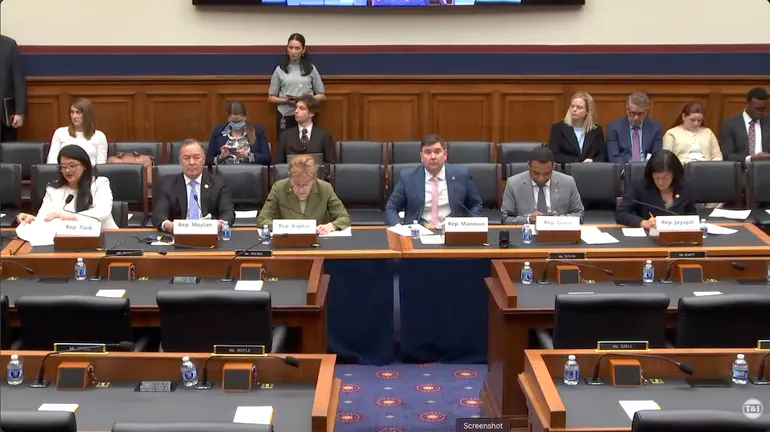
During a Jan. 14 hearing held by the transportation committee, House members voiced district-specific transportation concerns. Rep. Kevin Mullin, D-Calif., highlighted railway crossing dangers, noting that “hundreds of Americans are killed or injured in accidents at railway crossings.” He proposed “new technology-driven approaches” such as lidar and artificial intelligence, and offered to work on expanding eligibility for existing rail safety grant programs.
Intercity passenger rail emerged as a priority for Reps. Jim Costa, D-Calif.; Pramila Jayapal, D-Wash.; and Steve Cohen, D-Tenn. Cohen is collaborating with colleagues to reauthorize the Corridor Identification and Development Program and the Federal-State Partnership for Intercity Passenger Rail Grant Program, the latter of which saw funding cuts by appropriators for the current fiscal year.
Highway modernization was central for Rep. Ben Cline, R-Va., and Rep. Mike Flood, R-Neb. Flood seeks a new 13-mile highway east of Lincoln, while Cline advocates for upgrading Interstate 81 in Virginia, noting the “aging road has not kept up with the demands of users since it was first constructed over a half-century ago.” Rep. Emily Randall, D-Wash., called for increased ferry funding, stating, “My constituents rely on these boats every day.”
Funding the Future: Trust Fund Strains and New Proposals
Surface transportation funding has relied on a model established by the 1978 Surface Transportation Assistance Act, drawing from the general fund and the Highway Trust Fund (HTF), created in 1956 and largely fueled by fuel taxes. The 1982 reauthorization directed 20% of HTF revenues to public transit, a precedent that has continued, though transit hasn't always received the full allocation.
The HTF supplied 46% of IIJA's transportation funding. However, the Congressional Budget Office projects the fund will run out of money in 2028, largely because the federal gas tax has remained unchanged since 1993. Congress has repeatedly transferred general fund monies to shore up the highway account since 2007.
Last year, Rep. Sam Graves, R-Mo., chairman of the House transportation committee, proposed federal motor vehicle registration fees: $250 annually for electric vehicles, $100 for hybrids, and $20 for other passenger vehicles. While the House approved these fees during consideration of the One Big Beautiful Bill Act, they were excluded from the final legislation. (Transportation committee staff did not respond to interview requests for Graves.)
The NLC supports gradual increases in federal fuel taxes indexed to inflation, Kohler said. She added that any new revenue mechanism should be fair, protect privacy, and provide a more reliable income source than the current system, while accounting for alternative-fuel vehicles.
The HTF's mass transit account may face existential risk. Politico reported in November that the Trump administration floated eliminating it. Larsen indicated this idea was poorly received in the House committee, noting Graves was “really clear that eliminating the mass transit account was a nonstarter.”
Beth Osborne, president and CEO of Smart Growth America, offered a more radical critique: “I'd rather the trust fund be ended; throw the whole program into regular appropriations for better oversight.” She argues the current system favors new construction “that we cannot afford to maintain while the rest of the system is crumbling,” advocating for a “fix-it-first approach.” Osborne concluded, “It's not a tweak; it's turning things on their head.”
Discretionary Grants vs. Formula Funding
The IIJA and prior authorizations have used both formula funds and competitive grants. Formula grants are distributed by the Transportation Department to states, tribal authorities, and transit agencies based on congressional parameters. Competitive grants can go directly to states, local governments, transit providers, nonprofits, universities, and other entities.
“We need to maintain a level of flexibility for states.”
— Rep. Rick Larsen, Ranking Member, House Committee on Transportation and Infrastructure
The American Association of State Highway and Transportation Officials recommends Congress prioritize formula funding over discretionary grants. Larsen supports this flexibility, noting “city and state officials all play an obvious, important role in establishing what their local transportation plans are.” Kohler cautioned that if Congress shifts toward formula funds, “local governments need to maintain access in those formula programs.” Naramore argued that local governments are “best equipped to identify needs,” while APTA's McCarragher affirmed strong support for both funding types for public transit.
Timeline and Political Prospects
The legislative path is fraught. A 43-day government shutdown in late 2025, triggered by disputes over Affordable Care Act subsidies, underscores the gridlock. Another shutdown looms, as Senate Minority Leader Chuck Schumer stated Democrats would oppose a spending package including Department of Homeland Security funding, following the Jan. 24 death of a Minneapolis man shot by federal agents.
The surface transportation bill must pass by Sept. 30, just ahead of the November midterm elections. Kohler sees a narrow window: “There is a sweet spot here of timing where they are either going to make it happen before the midterms or it will be tied up.” She stressed the need for authorizers to “work with the appropriators.”
Zimmerman predicts the deadline will be missed, warning of a “pretty significant drop in funding.” Osborne is more pessimistic, doubting passage this year or in 2027. Larsen, however, remains hopeful, citing the committee's bipartisanship history. “There will be issues where Democrats and Republicans disagree, but [Graves] and I have been through this before,” he said. “We've been on this committee for 25 years together.” He added, “We're going to try to bring people along … so that we get a good bill that we can all support.”


