
Ten Key Provisions of the PRO Act Could Reshape the U.S. Labor-Management Relations Landscape
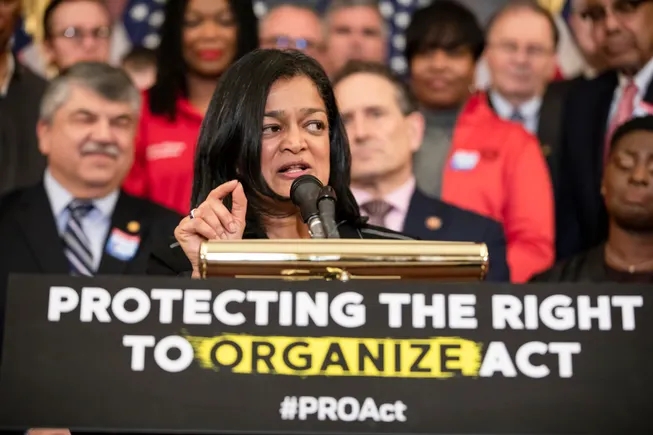
As a significant proposal in U.S. labor legislation, the PRO Act is sparking widespread discussion. The bill aims to amend multiple laws, including the National Labor Relations Act, by expanding the definition of employee, overturning state 'right-to-work' laws, and increasing penalties for violations to strengthen union organizing capacity. Supporters argue it would promote workers' rights and racial economic justice, while opponents worry it would disrupt the franchise model and small businesses. Based on Senate hearing testimonies and expert analysis, this article systematically interprets the bill's ten potential impacts.
American labor organizations are experiencing a period of activity not seen in decades. Marty Walsh, who took office as Secretary of Labor in March, is the first secretary from a union official background since the Ford administration. President Joe Biden established a special task force in April dedicated to enhancing workers' organizing capacity.
Now, a bill is before the Senate for consideration—if passed, it will either empower workers to democratize their workplaces or herald the end of small businesses, depending on whom you ask. At the July 22 Senate hearing on the Protecting the Right to Organize Act (PRO Act), witnesses included Gracie Heldman, a worker at an industrial bakery in McComb, Ohio, who said her employer harassed and intimidated organizers; and Jyoti Sarolia, owner and managing partner of a California hotel company, who argued that the bill's independent contractor and joint employer provisions would harm franchisees.
The bill, which passed the House in March, would amend the National Labor Relations Act (NLRA) and parts of the 1947 Labor-Management Relations Act and the Labor-Management Reporting and Disclosure Act, restricting certain employer practices and granting union organizers rights in the workplace.
Here are ten ways the bill could change today's workplaces.
1. More workers would be classified as employees rather than independent contractors.
The independent contractor provision is arguably the "most controversial" part of the bill, Patricia Campos-Medina, executive director of Cornell University's Worker Institute, told HR Dive. The provision would expand the current definition of "employee" to cover many workers currently classified as independent contractors by employers.
The bill adopts the "ABC" test, classifying someone as an independent contractor only if they: (a) are free from the employer's control or direction; (b) perform work outside the usual course of the employer's business; and (c) are engaged in an independently established trade, occupation, profession, or business of the same nature as the work performed.
Some states, such as California, already use the ABC test for issues like wage and hour and unemployment. California and a few other states have also passed laws excluding app-based drivers from independent contractor classification.
Under the PRO Act, the employee classification would "codify" the ABC test "so that it applies to determining who is eligible for coverage under the National Labor Relations Act," said Mark Pearce, former NLRB chairman and witness at the July 22 hearing. In other words, under the PRO Act, workers would be designated as employees to better access the NLRA and the expanded organizing and collective bargaining rights in the proposed law.
Campos-Medina said many app-based gig workers are misclassified as independent contractors, especially in areas like warehousing, administrative work, and healthcare. "We call it the 'permanent independent workforce,'" she said, "because they've done the same work for the same employer for years and are still treated as independent contractors." A report released in October 2020 by the progressive National Employment Law Project estimated that the misclassification rate among U.S. workers ranges from 10% to 30%.
Some in the business community have expressed concerns about the potential impact of expanding the "employee" classification. Sarolia, testifying at the International Franchise Association hearing, said the ABC test "could define franchisees as employees of the brand rather than the independent small business owners they truly are."
2. State "right-to-work laws" would be overturned.
According to the National Conference of State Legislatures, 27 states have "right-to-work laws"—laws that prohibit employers and unions from reaching "fair share" agreements, where employees must pay "fair share fees" to the union that represents them. In other words, workers in right-to-work states cannot be compelled to pay union dues. (People sometimes mistakenly think right-to-work laws give workers the right to refuse to join a union, but that right is already granted at the federal level by the NLRA.)
The PRO Act would require states to allow private employers and unions to reach fair share agreements, so unionized workplaces could charge all workers fees, even if they are not union members.
Those who advocate for repealing right-to-work laws say these laws weaken organizing power. Right-to-work laws "starve unions," Heidi Shierholz, senior economist and policy director at the Economic Policy Institute and hearing witness, told HR Dive. "The law requires unions to represent all workers—to represent everyone in the bargaining unit—but they can't charge any fees for those services."
Opponents argue these laws are about worker freedom and are essential for economic growth. "Alabama's right-to-work law has been great for the state because we're in the automotive industry," said Alabama Republican Senator Tommy Tuberville at the hearing. "Many industries would stall without such laws, especially in Alabama. Employer costs would skyrocket, potentially leading to job losses. Not to mention, states like Alabama would lose their ability to recruit companies."
3. Employers would face hefty fines for firing workers trying to organize a union.
One of the most critical provisions of the PRO Act is that employers would face fines of up to $50,000 to $100,000 for firing workers attempting to organize their workplace.
Shierholz told HR Dive that currently "there are no civil penalties for violating the NLRA; ... if a worker is illegally fired for organizing activity, which happens often, even if the employer is found guilty by the NLRB, there's no penalty. They just have to pay back pay to the fired worker, minus any income the worker earned in the meantime." Shierholz said current penalties are so weak that workplaces often have an incentive to break the law to prevent unionization risks.
"The biggest obstacle to organizing workplaces right now is employers' ability to fire workers and retaliate for union activity," Campos-Medina said. "If we can eliminate retaliation ... I think we'd see more unions."
4. Employers could no longer hold mandatory "captive audience meetings."
Another way some managers try to influence union campaigns is through so-called "captive audience meetings," which employees may be required to attend. These events are "fear meetings," Campos-Medina said. "They tell employees, 'If you join a union, you'll lose your job.'"
Heldman described in her testimony meetings held after workers filed a petition represented by the Bakery, Confectionery, Tobacco Workers and Grain Millers International Union: "They told us the plant could close, we'd lose wages and benefits, and be forced to strike," she said. "If we didn't attend these meetings, we'd be fired."
The PRO Act would prohibit mandatory or coerced attendance at captive audience meetings and employer "campaign activities" unrelated to job duties.
5. Union-employer contracts would be reached faster.
Shierholz told HR Dive that after employees vote to unionize their workplace, employers sometimes use "delay tactics" to stall the formation of collective bargaining agreements—a tactic that can leave workers who voted for union representation in limbo for years. According to an analysis of NLRB data, hundreds of newly formed unions fight for contracts, with only 48% reaching a contract within a year; a quarter of unions don't reach a contract agreement within three years of formation.
"Even if a union wins an election and is certified as the workers' representative, the company can refuse to bargain with the union indefinitely," Campos-Medina said. "Negotiations get tied up in court disputes, and the contract never happens."
Pearce, now executive director and visiting professor at Georgetown University Law Center's Workers' Rights Institute, testified that a rehabilitation and nursing center delayed a collective bargaining agreement for seven years until a court ordered it to engage in bargaining efforts.
The PRO Act sets a timeline for the collective bargaining process, requiring timely mediation and, if no agreement is reached, the introduction of a tripartite arbitration panel—including one member selected by the labor organization, one by the employer, and one neutral third-party member.
The bill also prohibits delaying union elections by having workers and the NLRB set election procedures.
6. Union organizers would have access to employees' contact information.
A provision that has drawn particular concern from some opponents requires employers to provide voter lists to labor organizations seeking to represent employees. The lists would include employees' home addresses, work locations, shifts, job classifications, and, where available to the employer, landline and mobile phone numbers and personal email addresses.
Advocates of organized labor argue that providing such information is necessary for union representatives to communicate with employees, but opponents worry about coercion and harassment. "Providing (employee) contact information simply ensures that workers who would rather be left alone cannot be left alone," the conservative Competitive Enterprise Institute think tank wrote about this provision.
7. Employees would have the right to use work equipment for organizing activities.
The PRO Act would require employers to allow employees to use work communication devices and systems to communicate and conduct organizing activities, "unless there is a compelling business reason to deny or restrict such use."
"This means managers might see more distractions in the workplace due to increased union organizing conversations," David Pryzbylski, a labor and employment attorney at Barnes & Thornburg in Indianapolis, told the Society for Human Resource Management.
8. Employers could not require employees to waive class or collective action rights.
Among other documents signed at hiring, employers sometimes include arbitration agreements through which employees waive their right to participate in class or collective actions. Although such agreements were once challenged by the NLRB, in 2018 the Supreme Court upheld employers' right to use class arbitration agreements under the Federal Arbitration Act in Epic Systems Corporation v. Lewis.
The PRO Act would not allow employers and employees to enter into such agreements.
9. The joint employer provision could impact franchisees and staffing agencies.
Sarolia testified at the hearing that one element of the bill concerning the International Franchise Association is the joint employer provision, which would amend the NLRA to define a joint employer as a party that "shares or codetermines control over employees' essential terms and conditions of employment." Such a standard would make "franchise brands liable for actions taken by unit-level small businesses," Sarolia said. "This puts franchisees at risk of being sued for things they never did and have no power to prevent."
Under the joint employer provision, staffing agencies could also be interpreted as joint employers, thus bearing some responsibility for what happens to employees in their temporary workforce.
"These changes mean the franchise level would need to hire a lot of lawyers to oversee employment issues and claims over which franchisees have no control," Sarolia testified. "Ultimately, the additional costs to franchisors would translate into additional costs for independent owners like me, making the franchise business model unsustainable."
Shierholz disagrees that the joint employer provision would harm the franchise model. "The joint employer standard actually protects franchisees," she told HR Dive. "As it stands now, franchisees ... already bear all the responsibilities of an employer. They're already responsible for sitting at the bargaining table. The joint employer standard would only say, 'The parent company that actually controls how you operate—they also have to sit at the bargaining table.'"
10. Workers of color, especially Black employees, could see wage gaps narrow.
Finally—and of particular concern to Shierholz—the PRO Act, through provisions that strengthen unions, could create a more level playing field for workers of color, especially Black workers.
"It's worth noting the importance of unionization to racial economic justice," Shierholz said. "People of color are more likely to be unionized than white workers. More white people are unionized, but that's because there are more white people. Black workers are more likely to be unionized than white workers, and Black workers gain more from unions than white workers. Everyone benefits from unions, but the benefits are greater for people of color."
A 2016 report from the Center for Economic and Policy Research found that Black union workers earn on average 16.4% more than non-union Black workers, "even after controlling for systematic differences between union and non-union workforces."
Shierholz said that with the Black-white wage gap worsening over the past 40 years, unions could be one corrective measure. "A key factor in the widening gap is the decline of unions over the same period."