
Investigation of Public Toilet Shortage in American Cities and Response Strategies
Many American cities face a shortage of public toilets, with Philadelphia having only 4 toilets per 100,000 people, far below Madison's 35. This article examines cases in Philadelphia and Washington, D.C., to explore how cities address this challenge through installing standalone public restrooms and increasing maintenance staff, and analyzes historical context, social impacts, and future planning.
Editor's Note: This article isthe first in a seriesexploring how American cities are addressing public restroom shortages.
Few people would travel 180 miles round trip just to see a restroom, but Philadelphia city workers did just that in March—they traveled to Hoboken, New Jersey, to inspect a standalone public restroom.
Like many U.S. cities, Philadelphia has a severe shortage of public restrooms. According to data from British bathroom supplies company QS Supplies and restroom finder app PeePlace,2021 dataPhiladelphia has only 4 restrooms per 100,000 people. In contrast, Madison, Wisconsin, has 35 restrooms per 100,000 people, the highest ratio among U.S. cities.
Philadelphia realized that even city workers face difficulties finding restrooms.
"In unfamiliar places, I don't know what to do other than find a Starbucks or a restaurant," said Cristina Laboy, environmental services manager at the Philadelphia Department of Public Health.
But that isn't always feasible, especially outside business hours, or when people can't afford to make a purchase to earn restroom access.
So, since 2019, Philadelphia has been experimenting with installing different types of public restrooms. This is part of a growing number of cities investing resources to address a basic human need—where is the nearest restroom.
Where did all the public restrooms go?
American cities have long struggled to provide adequate public restroom facilities. In the first half of the 20th century, pay toilets were the norm. According toPacific Standard magazineby 1970, there were more than 50,000 pay toilets in the United States. But activists began opposing this practice, arguing that charging for restroom use violated basic human rights.
By 1980, pay toilets had nearly disappeared, but free public restrooms did not correspondingly increase.
Today, public restrooms are hard to find in many U.S. cities, especially for homeless people. According to QS Supplies data, the United States has 8 public restrooms per 100,000 people, comparable to the Netherlands, Poland, Botswana, and Georgia. The best-performing country, Iceland, has 56 restrooms per 100,000 people.
Lezlie Lowe, author of "No Place to Go: How Public Toilets Fail Our Private Needs," said that today the number and accessibility of public restrooms depend on each city's efforts, but most cities have few public restrooms.
The scarcity of public restrooms disproportionately affects homeless people. More people become homeless in the United States each year. Lowe noted that they may need to use the restroom up to eight times a day, each time having to find one. When none can be found, urinating in public is often treated as a crime.
"We are very neurotic about restrooms and don't want to talk about them, so city council members or municipal officials discuss restrooms far less than other topics," Lowe said. "They aren't seen as neutral and vital urban infrastructure."
Lowe said many people have a "mental map" of restrooms along their daily routes. Starbucks is a frequent stop, but the companyannounced in Julythat it would change its policy of allowing anyone to use in-store restrooms, and employees can now deny restroom access to non-customers.
Because basic needs are met through this mental map, many people don't see public restroom scarcity as a problem.
"We all rely on this invisible network," Lowe said. "Most people think 'this isn't a problem.' Why would I be happy about the city spending $250,000 to install a restroom on the sidewalk, plus dealing with annual maintenance?""
So when proposals to install public restrooms arise, residents and civic groups sometimes oppose them, worried about what happens behind restroom doors, or unhappy about costs. But Lowe noted that not providing restrooms leads to more feces on sidewalks and outbreaks of hepatitis A.
Philadelphia discovered this. Kathleen Grady, chief of staff for health and human services in the Philadelphia Managing Director's Office, said that in 2019, in response to a hepatitis A outbreak, the city launched its first restroom pilot project. Hepatitis A transmission is linked to inadequate handwashing, and public handwashing facilities are as scarce as restrooms.
Philadelphia initially set up mobile restroom trailers. With the COVID-19 pandemic, the city increased the number of locations and added handwashing stations, Grady said. It then shifted to portable restrooms and increased their number to more than eight.
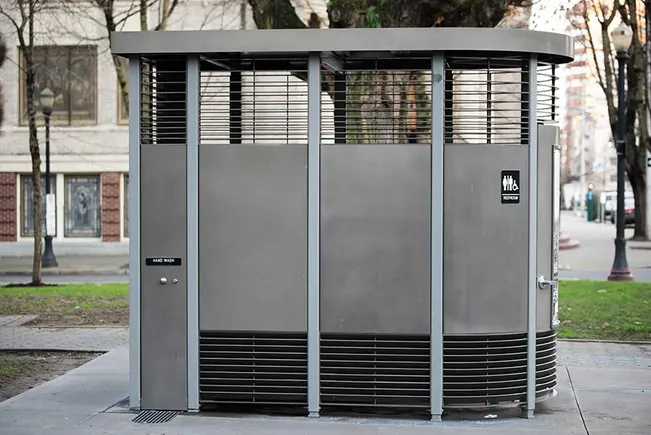
Now, Philadelphia has ordered its first Portland Loo, a standalone restroom developed by the city of Portland, Oregon. The restroom has beenused in more than 20 citiesincluding Hoboken, which Philadelphia workers visited.
"The Portland Loo is our attempt to make these restrooms permanent and more attractive to a broader range of people," Grady said. "Portable restrooms were initially a public health intervention responding to the needs of homeless people, but we're now taking a broader approach."

Grady said Philadelphia's first Portland Loo will be located downtown and is expected to arrive in the fall. Funding is already in place to install a total of six units across the city. Each Portland Loo costs $100,000, not including installation or maintenance.
Grady said the city determined restroom locations by visiting each neighborhood and looking at hotspots for homeless people and outdoor drug overdoses. The community engagement process allows residents to provide input on restroom locations and voice concerns.
Currently, Philadelphia has two public restroom attendants responsible for maintaining, disinfecting, and restocking portable restrooms, Laboy said. But the restrooms are not open 24 hours; they are only available during attendant working hours (8 a.m. to 7 p.m.). The Portland Loo will follow the same schedule.
The Portland Loo will be equipped with a baby changing table, a need the city discovered during the trailer pilot, and is exploring adding adult changing tables in the future. Restroom attendants will also be equipped with American Sign Language cards to help communicate with deaf users who use sign language.
"This is crucial to ensuring our public spaces are equitable, that people can actually use them, and that they are attractive," Grady said.
Washington, D.C., is in the early stages of its own restroom pilot. Keith A. Anderson, director of the D.C. Department of General Services, said that over the past 20 years, the city's population and density have grown, and there is now greater demand for public restrooms open outside business hours.
"In the past, downtown D.C. after 5 p.m. was a ghost town; now it's the complete opposite," Anderson said. "The city has changed, and the needs have changed. We want to ensure people can use public restrooms when they need them."
A spokesperson for the D.C. Department of General Services said the city is piloting the installation of two standalone restrooms, with $1.1 million in funding expected in fiscal year 2023. Anderson said that to better understand the restroom situation, D.C. just concluded a public comment period, and feedback will influence restroom locations, facility types, and whether they are open 24 hours.
In addition to adding facilities, the city may also reconfigure existing facilities, such as extending restroom hours.
"I don't think there's a one-size-fits-all solution for public restrooms," Anderson said.
Clarification: This article has been updated to clarify how Philadelphia equips restroom attendants to serve deaf users.