
Two cities take different paths to add public restrooms
San Francisco and Seattle have addressed public restroom shortages through municipal leadership and nonprofit-driven approaches, respectively. Data shows the United States has only 8 public restrooms per 100,000 people, far below Iceland's 56.
Editor's note: This article is the first of two parts exploring how American cities are addressing the shortage of public restrooms.This is the second of a two-part series.
In San Francisco, a 13-year-old's speech prompted city officials to confront the city's public restroom shortage. At a meeting in the Tenderloin neighborhood to discuss San Francisco's fiscal year 2014-2015 budget, a middle school student stood up and made a request to the city government: he hoped he wouldn't have to walk through feces on his way to school. Rachel Gordon, policy and communications director for the San Francisco Department of Public Works, said she was deeply moved by this.
"Hearing a 13-year-old say that was his experience walking to school in the morning is truly heartbreaking," Gordon said. "They should be talking about which boy or girl they have a crush on, what the math test will be like, what they'll do after school, not 'Can I get to school without stepping in something dirty?'" That very day, she and her colleagues at San Francisco City Hall began working to increase the number of public restrooms.
This is a nationwide problem: American citieshave failed to provide enough restrooms for their populations, especially for the homeless. According to data from UK restroom supply company QS Supplies and restroom finder tool PeePlacefrom 2021, the United States has only 8 public restrooms per 100,000 people, while Iceland, the best-performing country, has 56 per 100,000.
San Francisco'shomelessness rate is among the highest in the nation, and the city hopes to ensure residents have adequate access to restrooms, thereby preventing people from relieving themselves on sidewalks and streets and keeping the streets clean for pedestrians.
To determine restroom locations, the city examined areas with the greatest need. Gordon said city workers checked the areas with the most requests for steam cleaning services—requests typically related to cleaning up human waste. City employees also walked every block in the Tenderloin, documenting where feces were found.
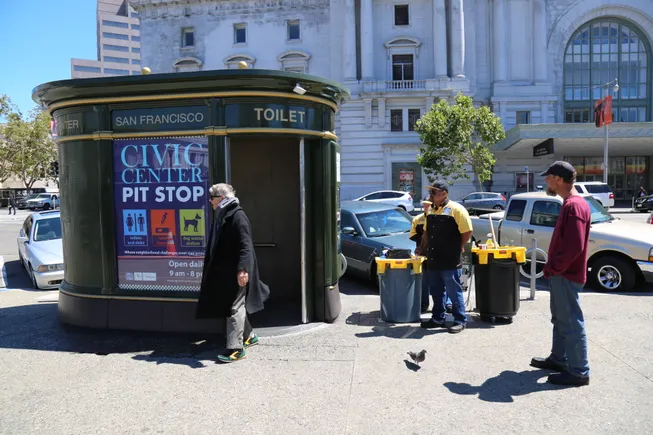
Three months later, in 2014, San Francisco's public restroom project started with three restrooms and became operational. Today, the city's Department of Public Works'Pit Stop programhas 33 locations. Additionally, restrooms are available in city buildings operated by other municipal departments, including libraries and recreation centers.
The city now has 26 public restrooms per 100,000 people, more than three times the national average.
Pit Stop restrooms have attendants during operating hours to ensure they remain clean and are used for their intended purpose. Many cities worry that public restrooms will be used for drug use, sleeping, or sex work.
"From the very beginning, we set the standard that parents could feel very comfortable bringing their young children into a Pit Stop," Gordon said.
Attendants check supplies such as toilet paper and clean the restrooms after each use, and also check for clogged toilets and needles on the floor. If a restroom is open overnight in an area with a higher risk of violence, two attendants are assigned.
Gordon said San Francisco has various types of restrooms: self-cleaning restrooms, portable restrooms, and restroom trailers.Ten of these locationsoperate 24 hours a day. In addition to toilets and sinks, each Pit Stop also has a needle disposal container and a pet waste station.

The operating cost of each Pit Stop depends on the type and hours of operation. According to Gordon and Beth Rubenstein, a spokesperson for the San Francisco Department of Public Works, in an email, a portable restroom open 8 hours a day, 5 days a week, costs $113,000 annually; a 24-hour, two-stall restroom trailer costs nearly $632,000 annually. The Pit Stop program's budget for fiscal year 2021-2022 was $12.7 million, covering maintenance, labor, and supplies, as well as grants to nonprofit organizations for restroom attendants.
Gordon expects the Pit Stop program to receive additional funding this fiscal year, allowing for more locations or extended hours. "Everyone needs a restroom," she said. "We should do our best to provide this service to everyone within the limits of our resources."
Seattle: Nonprofit advocates for more and better restrooms
In many cities, the installation of permanent public restrooms is often led by nonprofit organizations. Seattle nonprofit Real Change launched a campaign called "Everyone Poops" in 2019, calling on the city to add public restrooms. Tiffany McCoy, advocacy director at Real Change, said San Francisco's Pit Stop program inspired the organization. According to QS Supplies data, Seattle has 17 public restrooms per 100,000 people, but McCoy said public restrooms are still hard to find.
In 2019, Real Change persuaded the city council to allocate $1.3 million to build 5 Pit Stop locations, each with two restroom stalls, sinks, and needle disposal units. But McCoy said that after the COVID-19 pandemic broke out, the $1.3 million was redirected to other sanitation needs, and the restrooms were never built. "It was really frustrating," she said.
In a 2021 email toThe Seattle Times, the Seattle mayor's office said that after the pandemic began, the funds were transferred from the Human Services Department to Seattle Public Utilities. The funds were then used to deploy 12 sanitation stations equipped with portable restrooms and sinks, rather than the permanent facilities originally provided by the Pit Stop program. The city also set up two shower trailers. Funding for the shower trailers and portable restroomsis sustainable through 2022. The city did not respond to a request for comment on this article.
Early in the pandemic, Real Change launched a campaign to install temporary handwashing stations across the city. The nonprofit then realized that people were also using these stations to drink water or wash clothes. McCoy said these needs should not be borne by external organizations.
"Even for us to want to install a handwashing station in the city—just a basic handwashing station—is a huge undertaking. We don't have a full team dedicated to pushing for handwashing station installation. It takes so much energy, and these are ultimately services that the state and city should provide themselves," she said. "We don't have the capacity to run a public utility."
In the United States, however, the task of providing basic sanitation needs often falls on outside groups. NonprofitLava Maeprovides shower services weekly to homeless individuals in San Francisco, Los Angeles, and Oakland, California. The Greater Washington area'sfirst mobile shower programlaunched in 2021 next to a suburban metro station, operated by the Christian nonprofit The Neighborhood Well, open two Saturdays a month.
McCoy said some people associate public restrooms with crime and poverty, which is one reason some communities oppose their installation. "We live in a culture and a country that doesn't value public welfare," she said. "And there are people in power who enjoy deep privilege—they can walk into a coffee shop anytime, buy a cup of coffee, and use the restroom."