
Amtrak Unveils Ambitious 2035 Expansion Blueprint, Pending Infrastructure Bill Approval
Amtrak's CEO William Flynn has proposed a major expansion of the national passenger rail network by 2035, contingent on passage of the $1 trillion bipartisan infrastructure bill. The plan would add 30 or more new routes, increase service on at least 20 existing lines, and bring new service to up to 160 communities. However, the proposal faces hurdles including freight railroad cooperation, funding uncertainties, and questions about demand.
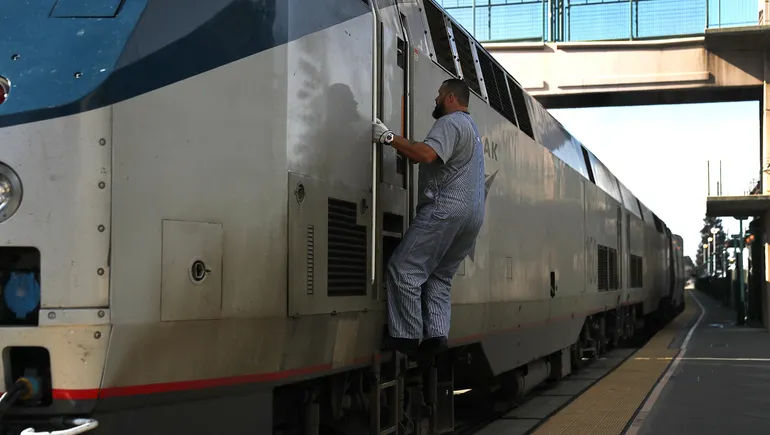
Columbus, Ohio's state capital, is home to nearly 900,000 residents and anchors a 15-county region that, according to William Murdock, executive director of the Mid-Ohio Regional Planning Commission (MORPC), is the fastest-growing area in the Midwest. Yet it also holds a less flattering distinction: "the largest city in the country that is not on Amtrak's national network," Murdock said. Columbus is among numerous cities and rural areas hoping to benefit from what has been described as the largest federal investment in passenger rail in Amtrak's 50-year history.
Earlier this year, amid the optimism of the Biden administration's first months, Amtrak CEO William Flynn unveiled a hopeful national route map, penciling in new and expanded passenger train service for many regions. The plan's fate now rests with Congress. If House Democrats agree to pass the $1 trillion bipartisan infrastructure bill, the railroad could receive a windfall exceeding $100 billion over the next five years. The bill guarantees $66 billion for freight and passenger rail, with an additional $36 billion subject to future congressional appropriations.
Transportation planners in the Midwest, Southeast, and West are closely examining the legislation's Corridor Identification and Development Program, designed to help states establish new intercity trains, expand existing routes, or restore prior services. Examples of existing routes that could grow include Chicago-Milwaukee; Washington, D.C.-Roanoke, Virginia; and Vancouver, British Columbia-Seattle-Portland, Oregon. Future new service could include Atlanta-Charlotte, North Carolina; Cleveland-Detroit; and Atlanta-Nashville.
"This sets up a better framework for the states and Amtrak to work together to expand service," said Mark Weitenbeck, treasurer of the Wisconsin Association of Rail Passengers. Under the new legislation, the U.S. Department of Transportation could support a project for multiple years through a phased funding agreement until the state or a multi-state compact takes over.
If the program is fully implemented by 2035, Amtrak expects to have added 30 or more new routes and increased service on at least 20 existing lines. Up to 160 communities would see new Amtrak service, and 15 states would gain multiple daily trips.
When Amtrak assumed responsibility for most of the nation's intercity passenger train service in 1971, it served 43 states with 184 daily trains. Although it now operates 300 trains a day in 46 states, parts of Canada, and the District of Columbia, its route map has changed little since 1971. This stagnation persists despite rapid population growth in Sun Belt cities like Atlanta, Phoenix, and Austin, Texas, and shifting job patterns across many regions. In 2019, the railroad carried 32 million passengers; it expects to add 20 million riders from the proposed intercity corridor expansion.
Robert Poole, director of transportation policy at the Reason Foundation, a free-market think tank, disagrees with that projection. "My biggest problem with this is the idea that there is a large unrealized demand for this sort of train travel," he said. "I don't think we have any evidence for that, and the cost of trying to stimulate it is very large."
Positioning rail as a driver of equitable development
In Ohio, Amtrak plans a new Cincinnati-Columbus-Cleveland route with connections to the national rail network on both ends. MORPC also advocates for a new east-west route linking Columbus to Chicago and Pittsburgh.
Columbus would need a new train station, and Murdock says developers are eyeing a location in the city center near the convention center and hotels. Murdock calls it a "booming area" but admits that housing is scarce in the Short North and Arena districts adjacent to the planned station. "We don't have enough housing to support our population growth at all different income levels, and so this is something we're really concerned about," he said.
Alon Levy, a fellow with New York University's Marron Institute of Urban Management who focuses on public transportation, believes office jobs "could fill in residential development near the station" in the city center, but noted that in Columbus, Cleveland, and other Midwestern cities, single-family housing begins within blocks of downtown, limiting commercial development opportunities.
Amtrak's Flynn said in a statement that the proposed federal investment will create jobs and improve equity across the country. An Amtrak-commissioned study supports that claim, concluding that the corridor plan would spur $195 billion in additional economic activity from capital investments between 2021 and 2035 and support more than 26,000 permanent jobs.
According to Amtrak's 2021 corridor vision plan, "the geographic expansion to areas with large Black, Indigenous, and People of Color (BIPOC) communities" will also help reduce racial and economic inequities. In Ohio, Murdock said the planning commission is exploring new train stations in underserved areas, complementing them with bus rapid transit and transit-centered housing.
Connecting urban and rural populations
Murdock added that rural communities in Ohio are often the most enthusiastic about getting train service. "They see the economic possibilities of bringing a station to their town, making them more attractive," he said.
Jim Mathews, president of the Rail Passengers Association (RPA), a pro-rail organization that predates Amtrak, cited Meridian, Mississippi, as an example of rail's economic value to smaller communities. That city of 36,000 built the Union Station Multi-Modal Transportation Center in 1997 on the site of a historic, mostly demolished 1906 train station. According to Amtrak, the initial construction cost of nearly $7 million helped generate $135 million in both public and private investment in the Depot District.
Jarod Pearson, president of the Tennessee Association of Railroad Passengers advocacy group, lives in Cowan, Tennessee, a community of just over 1,600 people. Although a freight rail line runs through his hometown, the nearest Amtrak station is in Atlanta, a three-hour drive away. That could change with Amtrak's planned expansion, which would add service from Atlanta to Chattanooga and Nashville, Tennessee, along that existing rail line. Pearson hopes Cowan becomes a stop. "I would make trips to Chattanooga more frequently," he said. "I would not hesitate to spend more time in the area if I can do so without the traffic worries, and that's part of the appeal of passenger rail." Train service would also help the region's economy and improve access to healthcare and jobs, Pearson added. "It makes rural areas more livable."
Rail roadblocks

While urban planners and passenger rail advocates call for more and better trains, roadblocks remain even if the infrastructure bill is enacted. Of Amtrak's 21,400 route-miles of service, it owns just 623 miles. It operates, maintains, and dispatches an additional 229 miles, but other railroads or government agencies largely own the rest. Freight railroads are notorious for causing major delays to passenger trains. Only one of Amtrak's 15 long-distance trains achieved better than 80% on-time arrival in 2020; six failed to achieve better than 60%. The Sunset Limited, running between Los Angeles and New Orleans, arrived on schedule for just one in three trips in 2020.
Freight railroads may resist additional passenger trains or require Amtrak to make expensive upgrades to their lines. In Maine, a passing siding along a Pan Am Railways-owned track needed to be lengthened by six miles to allow Amtrak to add a sixth daily round-trip between Brunswick, Maine, and Boston; construction is now underway. On Amtrak's Chicago-Milwaukee route, Canadian Pacific Railway said it would not agree to additional service after opponents in Glenview, Illinois, objected to the construction of two passing sidings the railroad required.
Poole pointed out that "there's policy implications that are not being discussed from the standpoint of greenhouse gas emissions and carbon footprint." He explained that America's freight railroads are optimized for efficiency. "To the extent that we, by deliberate policy, put a lot more passenger trains on to those freight rail lines, it's going to reduce the efficiency and cost effectiveness of transporting freight by rail rather than by truck."
Beth Toll, Amtrak spokesperson, said in an email that Amtrak has worked closely with host railroads and has held "years of discussion" about many proposed new routes. The RPA's Mathews is optimistic these issues can be resolved as Amtrak moves forward. MORPC's Murdock noted that in Ohio, "The types of investment that you need to make to deliver passenger rail service on these lines through Columbus would mean we'd also improve freight bottlenecks and freight speed."
Anecdotally, interest in more train service is evident. According to Murdock, "Whether we're talking about a large convention or a business or a young person who's moving to Columbus, oftentimes one of the questions they ask is, 'Where's the train station?'"
"America has a terrible history of prioritizing highways and driving above other modes of travel, destroying communities in the process," said Amtrak's Toll. "As a result, millions of people, including large populations of people of color, do not have access to reliable, fast and sustainable transportation options," she said, adding that Amtrak wants to "address that disparity."