
Las Vegas launches bus rapid transit line to boost ridership and service reliability
Las Vegas opened a new bus rapid transit line on Sunday, featuring 60-foot zero-emission hydrogen fuel-cell buses. The $378 million project, funded by federal grants and local sources, aims to cut bus travel time by 20% and serve 13,000 daily riders by 2040.
Dive Brief:
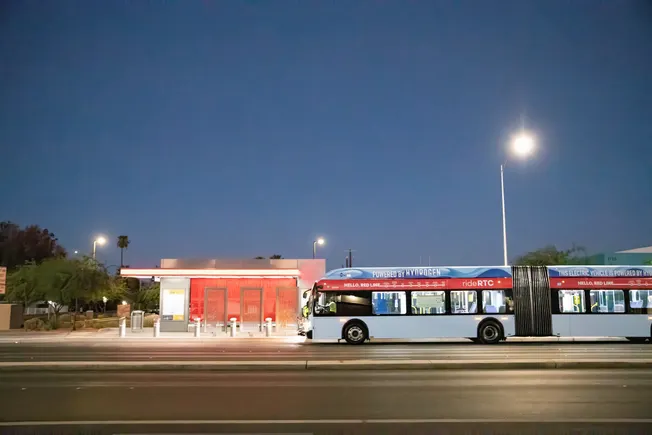
- The Regional Transportation Commission of Southern Nevada (RTC) opened a new bus rapid transit route in Las Vegas on Sunday, deploying 60-foot zero-emission hydrogen fuel-cell buses.
- The route connects downtown Las Vegas, the Las Vegas medical district, the University of Nevada, Las Vegas, and Harry Reid International Airport.
- Dedicated shared bus and bike lanes, widened sidewalks, and passenger amenities along the 7.3-mile Maryland Parkway corridor are designed to boost ridership and spur transit-oriented development, RTC Deputy CEO Andrew Kjellman told Smart Cities Dive.
Dive Insight:
The $378 million project, financed through federal grants, local funding, and sales tax revenues, is intended to benefit transit riders, cyclists, pedestrians, and motorists alike, according to Kjellman. Bus travel time along the corridor is expected to decrease by approximately 20% thanks to dedicated outside lanes and transit signal priority. During daytime hours, buses will operate every 12 minutes.
Ridership on the existing route dipped to about 9,000 daily passengers during construction, but the RTC projects that number will rise to 13,000 daily riders by 2040, Kjellman said.
In most locations, sidewalks have been widened from 5 feet to 10 feet, and trees have been planted along the route. “Extreme heat is a really big issue in Southern Nevada, and so we're adding street trees not only on both sides of the roadway, but down the center of the median as well,” Kjellman noted.
The corridor is home to 63,000 residents and 109,000 jobs, according to the RTC, and carries nearly 35,000 vehicles per day. Drivers will also benefit from re-timed traffic signals that accommodate traffic flow, Kjellman added.
The RTC collaborated with local government agencies “to bring development closer to the corridor,” he said. New buildings would also provide shade, making the route “a more inviting, livable and cooler corridor for our community.”
For now, fares on the new line will match those of other RTC bus routes, Kjellman said, but the agency is considering a fare increase next year. “As Southern Nevada continues to grow, we’re focused on delivering a better transit experience for every rider … Even as we navigate ongoing transit funding challenges,” RTC CEO M.J. Maynard-Carey said in a statement.
The Las Vegas BRT line is one of more than a dozen new transit projects expected to open this year. Many cities are opting for less expensive and more flexible bus rapid transit over light rail, according to Yonah Freemark, a researcher at the Urban Institute and creator of The Transport Politic, who spoke with Smart Cities Dive.