
From Shopping to Housing: Abandoned Malls Transformed into Senior Residences
The demand for affordable housing among America's elderly population is growing, especially in the wake of the COVID-19 pandemic. Some developers have begun converting abandoned shopping malls into senior housing to address the housing shortage. This article analyzes the practices and challenges of this innovative model, using Wayzata, Minnesota; Richmond, Virginia; Wheat Ridge, Colorado; and Irondequoit, New York as examples.
The demand for affordable housing among the elderly population in the United States is becoming increasingly urgent, especially in the context of the COVID-19 pandemic disproportionately impacting senior communities. As the population ages, this demand is expected to continue growing, and some developers are beginning to look at abandoned shopping malls for innovative solutions.
Long before pandemic restrictions, shopping malls across the United States were already struggling, with anchor stores like Macy's on the brink of bankruptcy at one point. Over the past decade or more, demolished mall sites have been transformed into medical centers, sports team training facilities, Amazon warehouses, car dealerships, and biotechnology laboratories, while others have remained vacant.
"If you want to be in a near-suburban location, this is where the land is," said June Williamson, chair and associate professor of architecture at the City College of New York. She noted that Northgate Mall, one of Seattle's oldest shopping centers, built in 1950, is an example of land reuse: the site is undergoing construction of high-density residential towers, a hotel, a planned transit hub, and a National Hockey League center.
Meanwhile, the mall's satellite parking lot has been transformed into senior housing called Aljoya Thornton Place. Williamson said the residence calls itself an "urban village" aimed at people who "love the vibrancy of the city but don't want to live downtown," which is attractive to healthy older residents when choosing where to live.
A National Association of Realtors survey from October 2020 found increased interest among Americans over 55 in homes close to sidewalks and within walking distance of grocery stores, restaurants, and retail shops. Williamson noted that these walkable senior communities "may be closer to social services, continuing education, healthcare, and public transit." She said, "A generation ago, senior living centers were like campuses in remote, pastoral areas that required long drives. But now people want to live near neighborhoods."
However, in many cases, available senior housing falls into two categories: expensive continuing care retirement communities (CCRCs), or relatively cheaper housing built using federal tax credits, which restrict the income of eligible residents—leaving senior communities to grapple with an oversupply of demand for affordable and convenient housing, said Danielle Arigoni, director of livable communities at AARP.
"By 2034, the population over 65 will outnumber those under 18 for the first time," Arigoni said. "Local governments have not sufficiently prepared to meet this demand. More than half of households have only one or two people, but over 85% of housing has two or more bedrooms. So there is already a real mismatch." AARP surveys have found that three-quarters of people want to age in their homes or communities, Arigoni said. Beyond Seattle, Smart Cities Dive identified four cities that are redeveloping mall sites to bridge the senior housing gap.
The Folkestone in Wayzata, Minnesota: Expensive and with a long waiting list
For some seniors, the best way to stay in a familiar community is to move to a senior living complex like The Folkestone, part of the Promenade development in Wayzata, a suburb of Minneapolis. The Promenade was built on the site of the old Bay Center Mall, which was built in 1967 and demolished in 2012. The senior housing portion was completed in 2015, and the entire project was finished in 2018.
About 75% of The Folkestone's residents come from within a 15-minute radius of the development, said Jon Fletcher, vice president of Presbyterian Homes & Services and Senior Housing Partners, in an email interview. The developer owns 51 senior living complexes in Minnesota, Wisconsin, and Iowa, but The Folkestone is its first project developed on an old mall site.
"The site was chosen for its prime housing location, as an infill property that is difficult to replicate, surrounded by walkable neighborhoods," Fletcher said. The developer faced few challenges building on the mall site, aside from common issues with old buildings, such as asbestos. The biggest issue was that the mall was originally built on wetlands, which made new construction more complex and expensive, Fletcher said.
The entry deposits for the senior apartments are refundable and range from $95,000 to $328,000, with monthly rents from $2,200 to $6,800. The waiting list at The Folkestone exceeds five years, and the demand is evident. Fletcher declined to disclose the project cost, but the Minneapolis Star Tribune reported it at approximately $342 million.
The Village in Richmond, Virginia: Bond issuance helps
In 1975, the nonprofit Westminster Canterbury Richmond (WCR) opened a large CCRC near the Azalea Mall in Richmond, Virginia, which closed in 1996. After the mall was demolished in 1999, plans for mixed-use development on the 50-acre site failed, and the site remained vacant except for occasional temporary markets or an Amazon temporary distribution center, said Gail Haglund, WCR's director of communications.
In 2018, WCR spent $7.9 million to purchase 10 acres of that land to expand its CCRC, planning to build a senior housing complex called "The Village." The complex will have three buildings, each with about 19 apartments, Haglund said. These will be independent living units, but residents will have access to the CCRC's medical services.
The entire expansion—of which The Village is just a part—is expected to cost over $100 million and includes a new spiritual center, dining venues, and a health and fitness center. Two years ago, WCR secured low-interest financing for the expansion through the Henrico County Economic Development Authority, according to the Richmond Times-Dispatch. County supervisors approved a $72.5 million bond issuance, and WCR said it would use $8.5 million of that for the new project.
The apartments are still under construction and are expected to be available within the next two to three years, Haglund said. There are already 200 priority depositors for the new units, meaning they have paid a refundable deposit and will get priority for occupancy. Exact rents have not yet been set. In a CCRC, residents pay a "substantial" entrance fee—refundable over four years—plus monthly fees, which remain the same regardless of the level of care needed, she said. The CCRC's waiting list exceeds 1,000 people.
Wheat Ridge Town Center, Colorado: Affordable housing tax credits
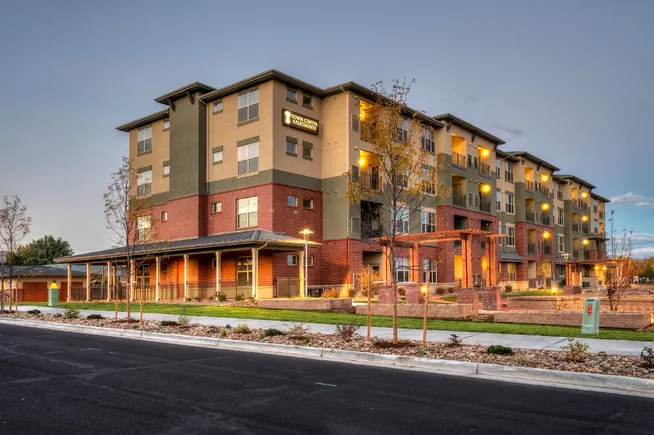
The Wheat Ridge Town Center senior apartments were built in 2012 in a Denver suburb on the site of a 1960s open-air shopping center. When the mall struggled in the 1990s, officials tried unsuccessfully to use it for antique shops, and the site eventually sat idle, said Tyler Downs, principal of senior housing developer Vazier Partners.
By 2011, the Wheat Ridge Urban Renewal Authority, "Renew Wheat Ridge," had purchased the 8-acre site with plans to transform it into a housing-focused mixed-use development. Vazier wanted to develop the site as an affordable "active adult" community for healthy adults 62 and older, along with traditional multifamily rental housing.
"Wheat Ridge agreed with us that it was important to provide housing options that cover all ages and income levels," Downs said. "This will continue to be a challenge for this age group, especially for low- and moderate-income individuals." Downs said the purchase was supported by federal affordable housing tax credits, allocated by the Colorado Housing and Finance Authority. "This allowed us to provide funding in exchange for keeping our rents low for 40 years," he said. "We receive funds in the form of tax credit equity, and residents get to live in brand-new buildings."
Downs said the city played a significant role in changing the zoning from retail to high-density low-income housing. It also provided infrastructure funding—new streets, curbs, sidewalks, and a road for the new development. Meanwhile, "Renew Wheat Ridge" hired consulting firm Weston Solutions for environmental cleanup, addressing asbestos and leaks from a former gas station and repair shop.
"If the city hadn't paid for the infrastructure, we couldn't have afforded it," Downs said. The entire project cost about $12 million, of which the city paid $2 million. The waiting list for the senior housing exceeds 1,300 people, while there are only 138 apartments, Downs said, with a turnover rate of about five years.
Skyview Park Apartments in Irondequoit, New York: Partnership with a local healthcare provider
In 1990, the Irondequoit Mall opened in a Rochester suburb. It thrived for about a decade but gradually declined and closed in 2009, with Macy's and Sears holding on until 2014 and 2016, respectively.
Now, part of the mall is being transformed by developer Pastone into "Skyview on the Ridge." The former Sears building will be converted into affordable senior housing with 78 apartments, while an adjacent new building will house another 80 apartments.
"We had to do some creative work to repurpose the Sears building," said Amy Cascia, senior vice president of development at Pastone Real Estate. The renovation raised the building's roof to create apartments and built an accessible courtyard to provide natural light and ventilation for each unit. Pastone also had to subdivide part of the property for utilities because it didn't want to share the same water line with the mall.
The apartments are expected to open in late 2021 and will be connected to each other and to surrounding developments via sky bridges—a useful consideration for seniors during upstate New York winters, Cascia said. To further support resident health, Pastone has also partnered with Rochester Regional Health to provide health screenings and referrals to medical and social services.
The units are for residents earning less than 60% of the area median income, which is $31,800 for a one-bedroom unit and $36,360 for a two-bedroom. Maximum rents are $710 for a one-bedroom and $1,023 for a two-bedroom, Cascia said. Pastone used the same affordable housing tax credits as Vazier in Colorado. The developer obtained a $22.4 million line of credit from Citizens Bank and $17.6 million in federal tax credits from New York State, through state channels and development loans.
"Typically, we buy the land and the building," Cascia said. "But this time, because it was part of the mall, we bought the store and had to lease the land underneath. We had to convince the state and the long-term permanent lender to be comfortable with that. It's not typical."
Despite a range of challenges, developers seem satisfied with the results of developing senior housing on old mall sites. "My advice to other developers is to strongly consider infill redevelopment opportunities as a way to revitalize underutilized properties that are typically well-located," said Fletcher, who worked on The Folkestone in Wayzata. "Of course, consider why a retail building is available for redevelopment. Is it because it's not the highest and best use? Or is it because it's in a bad location where any active use might not succeed?"
This article has been updated to more accurately reflect the planning details of the communities in Richmond, Virginia, and Wayzata, Minnesota.