
The greatest impact of the living wage ordinance may lie in public perception
Living wage ordinances have been implemented in multiple U.S. cities, covering only businesses with government contracts, but their greatest impact may be in shaping public opinion, paving the way for the current movement to raise the minimum wage.
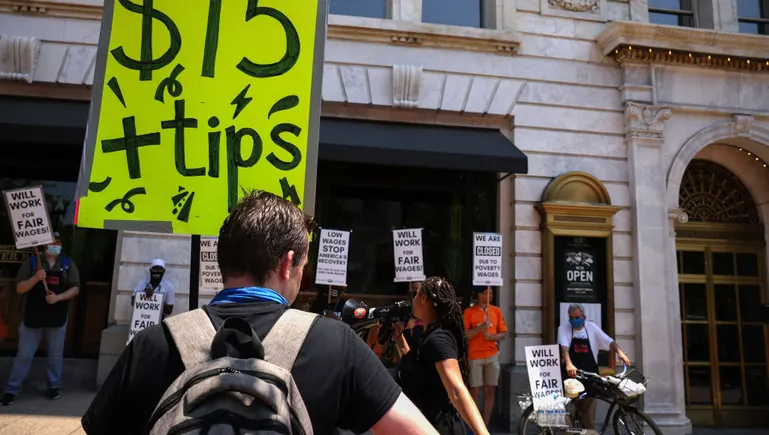
The minimum wage has long been a point of contention among workers, business owners, and governments. In recent years, some cities and states have raised the minimum wage to $15 per hour—but researchers say that in many places, this amount is still insufficient to help people make ends meet.
Before the "Fight for $15" movement, cities implemented living wage ordinances. These ordinances did not raise wages for everyone, but only for specific workers, typically those employed by businesses that hold local government contracts or receive local government assistance.
The city of Burlington, Vermont, passed a living wage ordinance in 2001, at a time when many cities were taking similar actions. The ordinance applies to any employer that receives at least $15,000 in payments from the local government within a year.
"From a political standpoint, it's certainly more acceptable because you're dealing with a small group of people who do business with the city," said Dan Richardson, Burlington's city attorney. "It's a self-selecting group. If you don't want to be subject to the living wage ordinance, then don't accept city funds."
Living wage ordinances exist across the United States, from Chicago to New Orleans to St. Petersburg, Florida. Researchers say these ordinances have a narrow scope, so they do not significantly impact the local economies where they are implemented, but they benefit both workers and employers. They point out that the greatest impact of living wage ordinances may lie in the current push for a universal minimum wage.
Origins of Living Wage Ordinances
Amy Glasmeier, a professor in MIT's Department of Urban Studies and Planning, says that in the 1980s, many local governments outsourced labor-intensive services such as park cleaning and garbage collection from in-house provision to private companies. She created and manages MIT'sLiving Wage Calculator。
But Glasmeier points out that the problem governments faced was that contractors failed to pay workers enough.
Baltimore passed the first living wage ordinance in the United States in 1994, requiring city contractors to pay workers at least$6.10 per hour(equivalent to $10.75 today according to the U.S. Department of Labor's inflation calculator).
Benjamin Sosnaud, a sociologist at Trinity University, says that at the peak of the movement in the 1990s and 2000s—when city minimum wages had not yet exceeded state minimum wages—about 125 cities implemented living wage ordinances. Collective bargaining groups, unions, and grassroots organizations considered living wage ordinances more politically feasible.
"In their view, the idea was that we're going to take a stand on this issue in a way we think we can achieve," said Sosnaud, who studies policy and inequality, including living wage ordinances. "Politically, getting this wage for all workers might not be achievable; it was beyond people's imagination. But let's fight for those who do business with the city."
How Cities Implement Their Ordinances
Chittenden County, where Burlington is located, is Vermont's economic engine. Richardson says the living wage ordinance helps cover people working for private businesses, especially in the service sector. When these businesses see increased profits, workers at the service level do not necessarily see raises.
"It's about limiting the gap between the rich and the poor," he said.
Burlington's current mayoral administration is auditing businesses to ensure compliance with the living wage ordinance. Richardson says that in the 20 years since the ordinance was implemented, the city has taken formal enforcement action against only two non-compliant businesses. Businesses that violate Burlington's law often hold multiple contracts in neighboring towns. In particular, companies that employ traffic flaggers (who direct traffic in construction zones) have a higher tendency to violate the living wage ordinance.
Burlington cannot provide an estimate of the number of workers covered by the ordinance, but Richardson says the city hopes to verify this number by auditing businesses. Seven Days, a Vermont alternative weekly, reported that more than 800 city employees are mostly covered by the ordinance, but that number does not include contractors and subcontractors working for Burlington.
Most living wage ordinances are passed by city governments, but Anaheim, California, is a recent exception. In 2018, voters passed the controversial Measure L, a union-backed initiative that raised wages for hotel workers receiving city subsidies. The new ordinance requires businesses to gradually increase the minimum wage for these workers to $18 per hour by January 1, 2022.
"As a city, we've always been hesitant to intervene in the relationship between employers and employees. Generally, we like to see ourselves as a business-friendly town that encourages investment," said Mike Lyster, a spokesperson for the city of Anaheim. "But of course, anything passed by voters and deemed legal and compliant, we certainly respect."
The ballot initiative targeted Anaheim's largest employer: the Disneyland Resort. But in November of this year, an Orange County judge ruled that construction bonds issued by Anaheim (including a parking structure operated by Disney) do not constitute subsidies. The Anaheim City Council, at the request of The Walt Disney Company in 2018,terminated all other tax incentives for the resort, and as a result, Disneyland is not subject to Anaheim's living wage ordinance.
Lyster says this leaves 650 workers affected by the ordinance, a number that could rise to 1,000 as Anaheim's tourism industry recovers and hotel capacity increases. All these workers are subject to the ordinance because of a luxury hotel tax abatement program that the city has since terminated.
Although Anaheim's living wage ordinance may have raised wages in 2018 and 2019, Lyster says that due to a tightening labor market, some companies (some of which are not subject to Measure L) are now paying higher wages.
"Today, almost all businesses in Anaheim face a worker shortage, so when demand for workers outweighs supply, you have to pay more," he said. "When I talk to hotel operators, including those affected by this, they say Measure L is no longer a factor for them because the market already is that way."
Dallas has seen a similar situation. In May of this year, the city council raised the minimum wage for construction contractors to $15 per hour. Ali Hatfield, assistant director of Dallas's Department of Public Works and city engineer, says there are currently 70 contractors working with the city on public projects.
Before the ordinance took effect in October, only federally funded projects paid $15 per hour. Hatfield says most of Dallas's public works projects do not receive federal funds. When the ordinance was passed,city officials reportedthat this would increase construction contract costs by 10%.
But Hatfield says most public works contractors already pay more than $15 per hour. Like Anaheim, Dallas has found that current market conditions have already pushed wages up, with or without the ordinance.
Glasmeier has observed the same situation. Companies often tell her they are already preparing to pay $15 per hour.
"The minimum wage is being left behind," she said. "(Business leaders) know they've been getting an extremely good deal with low wages."
Lasting Impact
When living wage ordinances were particularly popular in the 1990s and 2000s, businesses and business organizations united in opposition, but Glasmeier says such ordinances also have benefits. City governments have found that after contractor wages were raised, the quality of services improved. Higher wages also increase productivity, help work get done on time, and reduce accidents, she said.
Sosnaud adds that paying higher wages can boost worker morale and reduce company turnover.
But ordinances alone cannot bring about macroeconomic changes. Sosnaud studied the impact of living wage ordinances on urban labor markets and found that they do not affect poverty rates, average wages, or unemployment rates.
On the other hand, this also means that the ordinances do not worsen labor markets as some pro-business groups feared.
"Just passing an ordinance specifically targeting contractors or companies receiving business assistance doesn't redefine a city's poverty level or completely change the wage structure of its population," Sosnaud said. "But at the same time, it doesn't cause unemployment to skyrocket or ruin the city's economy as some pessimists at the time predicted."
He said that raising wages from $7 to $10 per hour makes a significant difference for many families, so these ordinances provide benefits at the individual level without negatively impacting the economy.
One of the most lasting impacts of living wage ordinances may be their legacy. These ordinances contributed to today's broader laws requiring higher minimum wages for all. Sosnaud says that currently, about 45 cities have minimum wages higher than the state minimum wage.
"I don't think this momentum would have developed as easily without some of the victories of the living wage movement paving the way," he said. "Building social movements and building coalitions takes effort."
Living wage ordinances provided a testing ground for people to organize for better pay. They also brought some successes that taught people strategies for building public opinion. Sosnaud says this is crucial for current efforts to raise the minimum wage.
Moreover, not all cities today have minimum wages higher than state wages. Therefore, ordinances in these places remain important for ensuring more workers are adequately compensated, he said.
Glasmeier also says that living wage ordinances have helped raise public awareness. "In the early days, city ordinances were very important in making people recognize the fallacy that the minimum wage is sufficient to make ends meet," she said.
Even when living wage ordinances are adjusted for inflation, they do not always keep up with the cost of living in a city. Currently, Burlington's ordinance requires paying$15.64 per hour. But according to MIT's calculator, the living wage for a single adult without children in Burlington is$16.27, and it rises with the number of children. Vermont has a high cost of living, and housing prices soared during the pandemic as people moved from cities like Boston to work remotely in the state.
Living wage ordinances remain part of the discussion.
"Living wages have always been a way for municipalities to express 'we should pay people and do our best to seek ways to let people earn a living wage,'" Richardson said. "In your city or town, the minimum wage may not be a living wage."