
The Electrification Journey of Traditional Automakers: How to Reshape the Competitive Landscape in 2022
At the 2022 CES exhibition, traditional automakers such as General Motors, BMW, and Hyundai intensively released electric vehicle models, marking a new stage in the electric vehicle market. Although Tesla still holds a first-mover advantage, traditional automakers, relying on brand heritage, cost control, and a deep understanding of consumer needs, are attempting to overtake competitors in the rapidly expanding electric vehicle field. Based on the views of multiple industry experts, this article analyzes the strategies and challenges of traditional automakers in areas such as marketing tactics, brand positioning, supply chain management, and emerging channels (such as the metaverse).
Although the Omicron variant cast a shadow over this year's International Consumer Electronics Show (CES), new product showcases in the electric vehicle (EV) sector remained the focus of the event. This technology extravaganza, typically held in Las Vegas, attracted numerous automakers including General Motors, BMW, Hyundai, Stellantis, and Daimler. Among them, some companies like General Motors shifted to online presentations due toCOVID-19 concerns, but their announcements still carried significant weight. Mercedes-Benz unveiled its long-rangeVision EQXX concept caryesterday, while General Motors' Chevrolet brand plans to showcase the electric version of its Silverado on Wednesday.
The dense EV announcement agenda at CES reflects a broad industry effort to narrow the gap with Tesla. Tesla, leveraging its first-mover advantage, has reshaped consumer expectations for sustainable mobility with almost no traditional marketing. After years of catching up, traditional original equipment manufacturers (OEMs) now see an opportunity: positioning themselves at the forefront of the industry as the tipping point for EV mass adoption approaches. However, truly seizing the opportunity in the rapidly evolving EV space may require thinking beyond conventional marketing strategies, even daring to experiment in the metaverse.
"None of the OEMs I've spoken with say 'we just want to match what's already in the market,'" said Brian Irwin, Managing Director of Accenture's North American Automotive and Mobility practice. "Everyone wants to leapfrog. They are more aggressive in EVs and have expectations of market leadership."
"This is increasingly an 'additive' space," Irwin added.
Following a series of new vehicle launches andcorporate rebranding effortslast year, EV marketing is expected to become more aggressive in 2022. As the segment expands into more popular vehicle types like pickup trucks, consumer enthusiasm is high. Product diversification also gives traditional automakers opportunities to communicate around their strengths, such as value for money and deep brand heritage—areas where new entrants lack.
"We are in the foundational communications era of this space," said Mat Zucker, Senior Partner at brand transformation consultancy Prophet. "The conversation will revolve around deeper differentiation. I think 'performance' will be redefined and broadened."
The Tipping Point Approaches
Current optimism about EVs stems from a series of 'false starts' in the sector. During the 2010s, EV adoption was slow due to stricter fuel economy standards for internal combustion engines and cost barriers.
Changing political landscapes and the stark reality of climate change may be building momentum. According to Ipsos data, consumer interest in EVs hastripled since 2018, a rise driven by increased consumer familiarity and more choices.
A study released by Accenture in September shows that nearly two-thirds of consumers nowidentify as 'sustainability-conscious drivers', with environmental considerations being a top concern. The study surveyed 8,500 respondents in the United States, China, and eight European countries.
"In 2021, we saw another wave of sentiment shift—a new administration pushing a more environmentally focused agenda than ever before, and the environmental issues our society faces began to surface more," said Accenture's Irwin. "I think that's why similar positive sentiment keeps building."
Affordability remains an issue for OEMs to address, but the sustainability premium is no longer seen as a huge barrier. Among the 'sustainability-conscious drivers' identified by Accenture, 30% are willing to pay 1%-5% more for a more sustainable vehicle, while over 60% are willing to pay at least 6% more. These findings suggest that EV appeal has moved beyond early adopters—the niche group primarily enthusiastic about the latest technology.
"When you target early adopters, the messaging is very much about sustainability and technology," said Lindsay Murtagh, Chief Client Officer at Omnicom's PHD agency. "Now it's evolved—depending on your target audience, the creative will dictate what message to deliver."
Beyond the 'Green' Narrative
If automakers' accelerated EV push in 2022 partly stems from the existential pressures of climate change, consumers shouldn't expect to see this mission directly reflected in marketing. In recent years, brands engaging with sensitive social issues has become common, but for automakers, this carries risks—their more urgent task is driving EV adoption rather than seeking praise on social media.
"If you look at brands promoting electric vehicles, sustainability isn't necessarily the primary message," said David Yang, Innovation Consulting Director at R/GA.
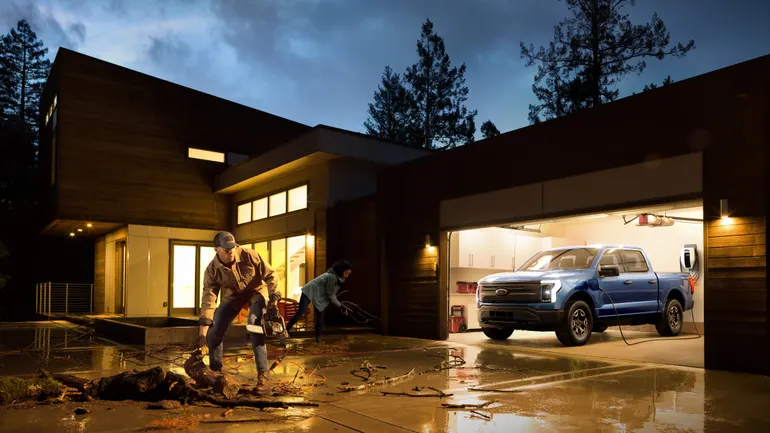
The Ford F-150 Lightning serves as a potential case study. Pickup trucks are typically positioned around practicality,and the vehicle's product pagedevotes significant space to features like 'phone-as-a-key' and Ford's Intelligent Backup Power. Due to manufacturing issues, Fordsuspended reservations for the vehicle in December, when orders had reached 200,000 units.
"Brands are being cautious, wisely avoiding alienating their customers."

David Yang
Innovation Consulting Director at R/GA
Prioritizing functionality may become a common theme, as OEMs need to communicate features like range to a public not yet accustomed to how EVs work. At least in the short term, automotive marketing may not undergo the fundamental transformation seen in other categories like consumer packaged goods in the 'purpose-driven' era.
"This sensitivity of brands to their audience and potential customers is a very savvy and smart approach," Yang said. "Brands are being cautious, wisely avoiding alienating their customers."
But that doesn't mean no EV brand will wave the sustainability flag. Rivian—although Ford's recent agreement to jointly develop EVs with it fell through, Ford still holds a stake—shares a grand mission on its homepage: "Keep the world adventurous forever"—accompanied by a clear photo of misty mountains. As sustainability becomes an important means of securing investment, more companies may also showcase their environmental credentials to shareholders.
Nevertheless, for more mainstream brands, marketing campaigns emphasizing price, performance, and accessibility will lead the way, while tapping into brand heritage through electrified classic models.
"The story about value... is the traditional OEMs' forte," Yang said. "They have a wealth of strengths and brand assets to draw upon."
Obstacles Ahead
Price and brand equity will also be important weapons against Tesla. Tesla has introduced cheaper models like the Model 3, but overall remains a premium brand.
"If all brands enter the market and product-level differences are flattened, then the brand and what it stands for will once again become key."
Brian Irwin
Managing Director of Accenture's North American Automotive and Mobility practice
The companydoes no traditional advertisingand has no PR department. Its leadership position is driven by word-of-mouth and the enthusiastic online following of founder and CEO Elon Musk—advantages that traditional OEMs without a startup background find hard to replicate.
"It's hard to discuss EVs right now without thinking about Tesla's enormous influence," Yang said. "While brands may not mention Tesla directly, they're certainly privately considering how to respond."
In the absence of CEOs who can inspire similar fanatical followings, traditional automakers can rely on household-name brands. Besides the F-150, familiar models receiving electric makeovers include the Mustang and Hummer—lineups previously with no connection to a positive environmental footprint.
"If many brands offer [pure electric] powertrains, the brand will become an important differentiator," Irwin said. "If all brands enter the market and product-level differences are flattened, then the brand and what it stands for will once again become key."
Another obstacle to traditional automakers' EV momentum comes from the supply chain. Semiconductor shortages remain a pain point across the industry, and the inability to meet demand could further disappoint consumers who have long felt EVs haven't reached their potential.
Experts warn that even with sparse showroom inventory, marketers shouldn't easily go silent on EV marketing. For example, Cadillac shifted its holiday marketing strategy from conventional discounts to brand-building campaigns to generate buzz for its all-electric Lyric model—scheduled to arrive at dealerships in Q1 2022. Pre-orders for the SUV sold out within minutes of going live in the fall.
"What we haven't stopped is strategic investment," said Melissa Grady, Cadillac's Chief Marketing Officer, at anAdvertising Week conferencein October, discussing supply chain challenges.
If other automakers want to stand out in an increasingly competitive landscape, this might be a strategy worth emulating. Meanwhile, those with actual inventory have an opportunity to enhance their image if competitors fail to meet production targets.
"Even if a specific model isn't in the showroom, it doesn't mean you can't advertise for the brand and support it," said PHD's Murtagh. "Opportunities always exist—maybe not at the bottom of the funnel, but more toward the top."
Exploring New Channels
Another experimental strategy that may be associated with EVs in 2022 is the metaverse, especially as physical showcases are constrained by the pandemic (like the COVID-19 concerns that disrupted CES).
Hyundai last year built a virtual space on the gaming platform Roblox to showcase its mobility and EV products, including the Ioniq 5 all-electric SUV. Roblox is popular with Gen Z and Gen Alpha, and this theme-park-like interactive experience—a world first among automakers—is clearly an effort to cultivate loyalty among the next generation of drivers.
While the metaverse won't become a major budget item for automakers in the short term, 2022 may see further testing of the waters, attracting emerging car buyers who are more familiar with spaces like gaming and more environmentally conscious.
"As younger buyers enter the market, EVs will certainly be attractive. Reaching these young potential customers on the channels they use will be crucial," Yang said.
"Given that not everyone is in the metaverse right now, it's almost a pragmatic way to experiment with things so you have the right baseline when these things really take off," he added.