
Autonomous Trucks Head Toward 'Driverless': Texas Testing Reveals New Industry Phase
In Lancaster, Texas, a Kodiak Robotics autonomous truck autonomously performed lane changes, avoidance maneuvers, and deceleration on Interstate 20. As Kodiak and Aurora Innovation plan to launch safety-driverless operations in Texas later this year, the industry stands at a critical juncture moving from 'assisted driving' to 'full autonomy.' Through on-site observations and multiple interviews, this article presents technological maturity, safety assessment frameworks, and diverse voices from the freight industry.
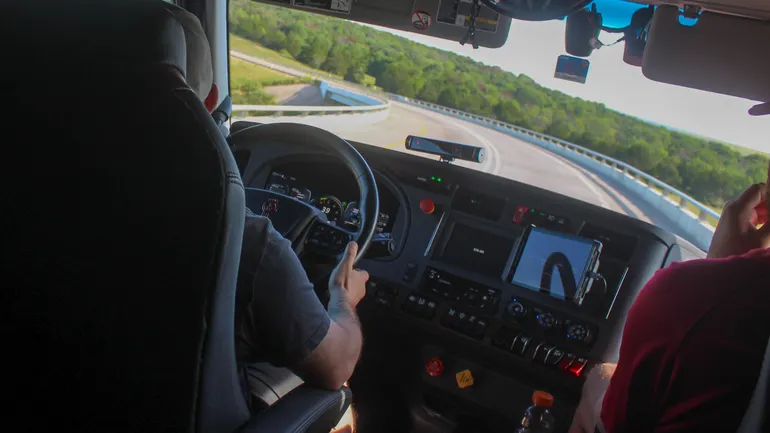
Lancaster, Texas — An autonomous tractor-trailer drove itself onto Interstate 20, safely merging into dense traffic, then slowed to 48 miles per hour as it approached a car stopped on the shoulder.
Kodiak Robotics safety driver Robert Roland kept his hands hovering over the wheel, ready to intervene if needed, while the company's technology handled traffic, hazards, ramps, and neighborhood roads near its hub during a morning demonstration trip near Dallas last month.
"It's a whole different world," said the third-generation truck driver.
AsKodiak RoboticsandAurora Innovationprepare to remove safety drivers from their autonomous vehicles on Texas public roads as early as later this year, Trucking Dive visited both companies' sites to get a close look at their progress toward full autonomy.
Autonomous trucks have been testing customer freight on public roads under the supervision of safety operators like Roland. This ride-along offered a glimpse into how ready these trucks might be for real-world driving scenarios.
"They drive defensively, they drive cautiously," said Daniel Goff, Kodiak's director of external affairs.

Safety first, with "no exceptions"
Kodiak's system is designed to be courteous to other drivers, slowing down and letting other vehicles merge.
"The system is designed to treat unknown objects like a human would: with extra caution," Goff said.

At the company's operations hub in Lancaster, Texas, Director of Operations Don Leppard pointed to a map on the wall showing routes where Kodiak delivers freight for customers and generates revenue. Lowercase "k" markers appeared across California, Florida, Georgia, Oklahoma, and Texas.
Another wall read: "Safety first, always. No exceptions."
At nearby Palmer, Texas, Aurora staff emphasized their safety measures and the company's technology at a busy autonomous vehicle hub.
Aurora trucks can operate in fog and light rain, and have strong capabilities even in downpours, President Ossa Fischer said in an interview.
But deployment in icy or snowy conditions could take years, she noted. Fischer compared autonomous trucks' precautions to airlines deciding not to fly due to hazardous weather.
"We believe this will actually improve road safety," she said, "because right now, there are trucks on the road when conditions really shouldn't have anyone driving."
At the Mid-America Trucking Show in Kentucky in March, Aurora senior safety specialist Brian Jones emphasized the company's focus on safety, noting that efforts aim to promote continuous improvement.
Jones said Aurora believes it "can always be safer and always strive" to improve the company and its technology.
The company is building a safety case and reporting that itsautonomous readiness metric was 95% complete as of mid-April. Aurora is seeking toraise that metric to 100%。

Current and future operations
Like Kodiak, Aurora uses a two-person crew model, with Aurora experts like Zach Riley monitoring the technology via a laptop in the vehicle, observing how the system perceives the environment, traffic, and hazards.
Riley noted that sensors on Aurora's lidar (short for light detection and ranging) cansee objects up to 400 meters away. He recalled that on a recent trip, the technology cut through dense fog, identifying and responding to traffic ahead before Riley could see it with his own eyes.
Because the technology enhances the vehicle's ability to navigate traffic environments, Riley compared it to a superpower. He said he wishes his personal car hadthis technology。
Supporters of the technology say that even when autonomous operations are fully deployed, job opportunities for drivers will still exist.
At Aurora's hub, personnel with commercial driver's licenses perform Commercial Vehicle Safety Alliance inspections on trucks each day before departure.
"We will always need and hire truck drivers," Jones said at the MATS show.
He noted that hubs have many moving parts and risks always exist, but company employees "also believe that by implementing smart solutions proven in other fields, we can reduce risk to a manageable level."
Jones also said safety training is not a one-time course that is never revisited: instead, he and Aurora's safety team regularly visit hubs to ensure training content is kept fresh.

Safety assessments continue
The National Highway Traffic Safety Administration has required parties involved in autonomous operations to provide details of crashes, helping track companies' safety records through a public database.
These incidents do not necessarily mean the autonomous vehicle was at fault; the database provides details of incidents over a nearly three-year period through April 15 of this year. Manufacturers and operators must report relevant information to NHTSA.
Kodiak recently recorded 3 million miles of real-world operation of its technology, reporting only three incidents. All occurred while the truck was being driven manually by a driver, and no injuries were reported.
In one incident on a Fort Worth highway in October 2023, a Kodiak truck was being driven by a safety driver at 34 miles per hour when a Class 8 semi-truck encroached into its lane, the company described in an NHTSA summary. Light contact scraped the SensorPod mounted on the mirror, and the autonomous safety driver pulled over.

The NHTSA crash database lists six Aurora incidents, with most occurring while the vehicle was in autonomous mode, according to incident summaries. Like Kodiak, no injuries were reported in these incidents.
A collision on a West Texas highway in March showed how the technology handles problems. According to an NHTSA summary, an Aurora truck was driving autonomously at 64 miles per hour when a car suddenly cut into the truck's lane, hitting the left rear of the trailer. Both vehicles were able to drive away from the scene.
Still, the possibility of more dangerous situations is raising concerns among truck drivers.
"We want to see the same rigorous standards and oversight as those who have proven themselves," said Lewie Pugh, executive vice president of the Owner-Operator Independent Drivers Association, noting that a top-performing truck driver can safely drive millions of miles.
The public should not be guinea pigs in road testing, an OOIDA spokesperson said in an email.
Setting safety standards is a tricky issue, said Chad Dittberner, senior vice president of van and expedited at Werner Enterprises, noting that the carrier currently hasmore than 600 driverswho have safely driven over 1 million miles without a single accident.
Dittberner, a member of theKodiak Industry Advisory Council, said safety is Werner's top priority for autonomous vehicles and the rest of its fleet.
"The ultimate goal is a truck that never has an accident," he said. "That aligns with what we expect from our drivers today."