
Open-Air Tuk Tuks Emerge as Viable Mobility Option in the COVID-19 Era
Amid COVID-19, city officials have focused on transit evolution, but open-air rickshaws (tuk tuks) are emerging as a key safe mobility option. Jacksonville's JTA partners with Go Tuk'n for shuttle service; pedicab operators in Austin and Denver see renewed interest. Experts highlight their role as transit complements, though regulatory and nightlife-related challenges persist.
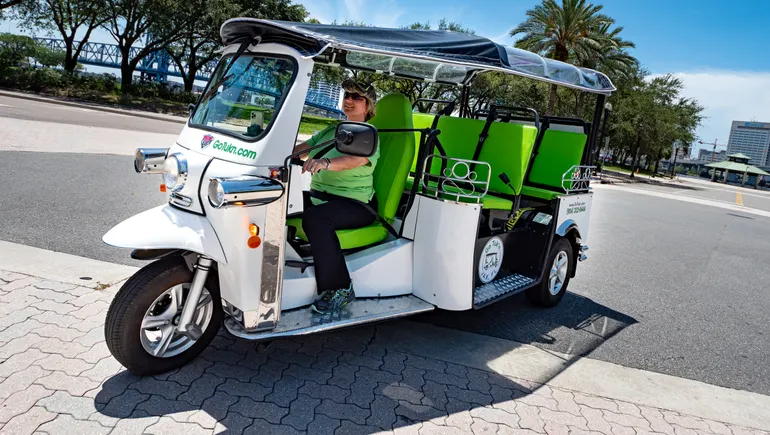
Over the past several months, urban policymakers have concentrated on the future of public transit, ride-hailing platforms, and autonomous vehicles as central mobility modes in the wake of the COVID-19 pandemic. Yet one category has largely been absent from these discussions—open-air rickshaws, commonly known as tuk tuks—which may offer a safe and sustainable transportation solution during the era of social distancing.
Typically associated with Asian and Latin American cities, rickshaws and tuk tuks have gradually joined pedicabs as a niche transportation option in select U.S. urban centers. Their open-air design, which keeps both passengers and drivers exposed to fresh air, is now positioning them as a practical choice for a period defined by concerns over enclosed spaces and viral transmission.
Jacksonville Partnership Signals Shift from Novelty to Necessity
Last month, the Jacksonville Transportation Authority (JTA) announced a collaboration with local operator Go Tuk’n to launch a pay-to-ride shuttle service traversing two downtown neighborhoods. The Tuk’n Ride initiative enables passengers to reserve trips on three-wheeled electric tuk tuks, ferrying them to nearby businesses and restaurants.
JTA spokesperson David Cawton characterized the partnership as adding a “door-to-door, on-demand service” to the agency’s mobility portfolio. He noted that public transit is experiencing a “difficult moment” as riders express apprehension about crowds and confined interiors, alongside a broader decline in commuter usage.

Go Tuk’n has operated in Jacksonville since early 2018, providing point-to-point trips and special-event services such as historical tours. The JTA partnership, however, elevates the company beyond its previous tourist-oriented or event-based identity.
“If we can show how to move people around urban areas, we might have people saying, ‘I don’t have to bring my own vehicle downtown,’” said CEO Stephanie Dale. “We cover distances that aren’t walkable, and we can get onto the roads that buses can’t do very easily.”
Historical Roots and Modern Evolution of Tuk Tuks
The use of rickshaws and tuk tuks in Asian and Middle Eastern cities spans more than a century, with origins as human-powered carts. During the 20th century, manufacturers introduced motorized versions that proliferated across Southeast Asia, India, and the Middle East; one notable model, the Mazda-Go, represented Mazda’s initial foray into automobile production.
Stable and compact, these vehicles have served as taxis, delivery conveyances, and alternatives to traffic congestion. However, they have also faced criticism for obstructing bus lanes and contributing to air pollution when running on conventional gasoline. In 1998, India mandated that its tuk tuks operate on natural gas, and recent years have seen a rise in electric models.
In the United States, adoption has been limited, partly due to regulations that restrict their presence on car-centric roadways. Existing tuk tuk services have largely retained a novelty status, often adorned to attract tourist attention. Yet the emergence of electric variants is changing the landscape. Denver-based eTuk introduced a street-legal electric tuk tuk service in 2017 and began distributing vehicles to other cities, paving the way for broader acceptance.
Advocates now contend that the shift toward open streets and open-air transit could enable rickshaws to compete with ride-sharing, scooters, and bicycles as a viable first-mile, last-mile solution. “We think that when people are getting back to work or are out in public when it is safe to do so, that having this kind of service established will be better for us and for our riders,” JTA’s Cawton told Smart Cities Dive.
Pedicabs as 'Ambassadors to the City'
Similar to rickshaws and tuk tuks, pedicabs—typically three-wheeled, pedal-powered vehicles—have addressed urban transportation needs in U.S. cities for several decades.
Steve Meyer, founder of Denver-based Main Street Pedicabs, first encountered pedicabs during a trip to India in his 20s and was struck by their “cute” appearance. A self-described “big guy,” Meyer recalled that he and a friend nearly collapsed the first pedicab they sat in. Years later, while living in Colorado, he began contemplating their role in urban planning, envisioning how they could occupy space typically reserved for cars. In the early 1980s, he borrowed a pedicab to shuttle attendees at an urbanism conference in Boulder, an experience that led to the creation of his company.
Meyer designed several pedicab models and launched fleets nationwide as an early alternative to short-haul taxi rides. He also targeted Denver’s emerging LoDo (“Lower Downtown”) neighborhood, where sidewalks were sparse and taxis were unreliable. “We’d do a lot of work taking people where taxis didn’t want to take people. We don’t want to make airport trips, we want to take people a quarter mile or a half mile,” Meyer said. “The pedicab industry really depends on people not wanting to walk short distances, or at least short from the standpoint of what we think of for automobiles.”
Decades later, pedicabs and motorized alternatives have established a presence in several cities, particularly those with dense nightlife districts or festival scenes. Austin, TX, for instance, maintains a fleet of pedicabs that helps circulate hundreds of thousands of attendees at the annual South by Southwest and Austin City Limits events.
Hey, #SXSW!
Look for a #Samsung #pedicab for a free ride to free swag! Samsung is exhibiting their new #SamsungGalaxyS10 at 701 Trinity Street, and they'd like to show y'all a good time.
And so would we. #LetsRide#SXSW2019 #SamsungExperience #SamsungGalaxy #Austin #ATX pic.twitter.com/pR54bL580I— Movemint Bike Cab (@movemintbikecab) March 15, 2019
“I think of ourselves as ambassadors to the city and to events. It’s outdoors, you get the sights and sounds of the city,” said David Knipp, co-owner of Austin’s Movemint Bike Cab, which operates a fleet of more than 60 vehicles. “We don’t always take the main thoroughfare, we go through the alleys and trails and show the road less traveled.”
In 2019, the City of Austin initiated a pilot program permitting e-assist motors on pedicabs, enabling vehicles to travel up to 30 miles per shift (compared to 15) and assisting drivers with the city’s steep hills. That pilot was made permanent last year, and the city expanded operational boundaries to enhance the vehicles’ reliability as a mobility option.
Assessing Safety and Regulatory Challenges
The integration of rickshaws, tuk tuks, and pedicabs into U.S. urban transport remains uneven, hindered by regulatory gaps or concerns that these vehicles obstruct sidewalks. New York City, for example, has experienced a strained relationship with pedicab operators, particularly regarding fare regulation.
Nevertheless, these vehicles can serve as a “complement to transit,” according to David King, an assistant professor in the School of Geographical Sciences & Urban Planning at Arizona State University. “They won't work to replace commuting, for instance, but perhaps as more cities and suburbs create ‘lifestyle centers’ rickshaws can be part of a ‘park once’ strategy, where there are fewer, but shared, parking lots rather than each business having its own lot as is currently the norm,” King said in an email. “Anything that helps reduce parking coverage will contribute to better places that are more walkable.”
This principle underpins the Jacksonville program, where tuk tuks are intended to replace a fleet of smaller shuttles that became prohibitively expensive to operate. The new vehicles offer a more personalized experience, capable of traveling from a bus stop directly to a business via side streets unsuitable for fixed-route buses. Dale emphasized that the new routes will help spotlight local enterprises. “Jacksonville is not some cookie cutter environment. I really want people to see the things about the city that I love,” Dale said. “It’s so rewarding to hear people say ‘I didn’t know this was here,’ that’s the experience we want on any shuttle ride or tour of any kind.”
The open-air nature of tuk tuks also provides a distinct advantage over ride-sharing and conventional shuttles, particularly at a time when airflow is paramount. In Naperville, IL, a suburb of Chicago with approximately 150,000 residents, the owners of Tuk Tuk Naperville surveyed their social media followers during reopening to gauge interest in resuming service. Most respondents indicated they would still use the service to reach downtown restaurants, according to company president Bill Hamik. Although sales remain “way down,” sufficient point-to-point rides have kept the business operational. Drivers continue to require masks and offer hand sanitizer, but the open-air configuration has alleviated passenger concerns. “I think that somewhat deflects concern about the spread of the virus,” Hamik said, adding that the company will adhere to all state and federal guidance.
In many cities, pedicabs and rickshaws are closely tied to nightlife culture, a sector now facing restrictions aimed at curbing crowding in bars and restaurants. Nashville Mayor John Cooper announced last month that the city would suspend “pedicabs, pedal carriages and limousines” as part of an extended closure for bars through the end of the month.
Conversely, some municipalities are actively supporting the industry. Austin has offered fee deferments and allowed fleets to keep non-operational pedicabs in suspension without forfeiting licenses, which are capped. The city’s initiatives to open streets for active transportation and add temporary bike lanes have also bolstered the sector, according to city spokesman Jacob Barrett.
Changes to street layouts—if they persist beyond the pandemic—could present significant opportunities for rickshaw and pedicab operators. As parking spaces are converted to outdoor dining and entire streets are closed to vehicle traffic, tuk tuks or pedicabs may facilitate movement in ways that ride-hailing vehicles cannot, said Main Street Pedicabs’ Meyer. That is, provided cities reopen fully. “When are people going to go back to a theater? That’s a question that affects my business a lot more than the disease,” Meyer remarked. “If people aren’t downtown, my vehicle’s not even going to be on the street.”