
From Retail to Residence: Repurposing Vacant Malls for Senior Housing
With a growing senior population and a shortage of affordable housing, developers are turning abandoned shopping malls into senior living communities. This trend repurposes underutilized retail sites to meet the demand for walkable, accessible housing, as seen in projects from Minnesota to New York.
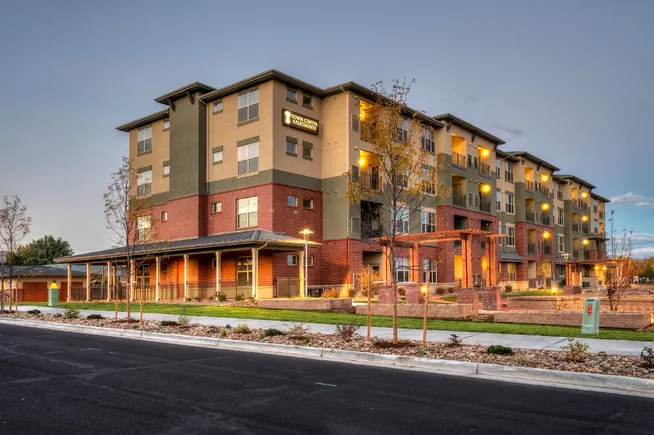
The nation's senior population faces a critical shortage of affordable housing, a challenge intensified by the COVID-19 pandemic, which has disproportionately affected older adults. As demand is projected to rise with an aging demographic, some developers are exploring innovative solutions by repurposing abandoned shopping mall sites.
Shopping malls across the country were struggling well before pandemic-related restrictions, with anchor stores like Macy's having teetered on the edge of bankruptcy. For over a decade, demolished mall sites have been transformed into medical centers, sports training facilities, Amazon warehouses, car dealerships, and biotech labs, while others have remained vacant.
"If you want to be located in close-in suburbs, this is where the land is" for developers, said June Williamson, chair and associate professor of architecture at the City College of New York.
Williamson cited one of the country's oldest malls—Seattle's Northgate Mall, originally built in 1950—as an example of how such land can be repurposed for housing. The site is undergoing construction for a high-density residential building, a hotel, a planned transit center, and a National Hockey League center, among other facilities.
Meanwhile, the mall's satellite parking lot was converted into senior housing called Aljoya Thornton Place, said Williamson. That housing describes itself as an "urban village" for people who "love the energy of urban life but don't want to live downtown"—a significant draw for healthy older residents seeking a place to live.
An October 2020 survey by the National Association of Realtors found that Americans over 55 have an increased interest in homes near sidewalks, where residents can easily walk to grocery stores, restaurants, and retail.
Some of these walkable senior communities "might have closer proximity to social services, continuing education, medical care, and mass transit," said Williamson. "A generation ago, senior living centers were like campuses, with a long drive, in a remote bucolic area, set apart. [But] people want to live near their communities."
Yet in many cases, available senior housing falls into two categories: expensive continuing care retirement communities (CCRCs) or relatively inexpensive housing built with federal tax credits, which caps the income of eligible residents—leaving senior communities to grapple with an overabundance of demand for affordable and accessible housing, said Danielle Arigoni, director of AARP's Livable Communities.
"In 2034, there will be more people over 65 than under 18 for the first time ever," said Arigoni. "Localities have not adequately stockpiled to meet that need. More than half of households have one or two people, but over 85% of housing stock is two or more bedrooms. So there's already a real mismatch."
AARP surveys have found that three-fourths of people want to age in their home or community, Arigoni said. Outside of Seattle, Smart Cities Dive has identified four cities with mall site redevelopments that aim to bridge the housing gap for seniors.
Folkestone in Wayzata, MN: Expensive with a Long Wait List
For some seniors, staying in a familiar community may mean moving to a senior living complex like Folkestone, part of the Promenade development in the Minneapolis suburb of Wayzata. The Promenade was built on the site of the old Bay Center Mall, constructed in 1967 and demolished in 2012. The senior housing portion was completed in 2015, with the entire project finished in 2018.
About 75% of Folkestone's residents come from within a 15-minute radius of the development, said Jon Fletcher, vice president of Presbyterian Homes & Services and Senior Housing Partners, in an email interview. That developer operates 51 senior living complexes in Minnesota, Wisconsin, and Iowa, but Folkestone is its first on a former shopping mall site.
"This site was chosen for its superior housing location as a difficult-to-replicate urban infill property surrounded by a walkable neighborhood," Fletcher said. The developer faced minimal challenges beyond those typical of old buildings, such as asbestos. Its biggest issue was the mall's former construction on wetlands, which made new construction more complicated and expensive, said Fletcher.
The senior apartments require a refundable entrance deposit ranging from $95,000 to $328,000, with monthly rent from $2,200 to $6,800. Folkestone has a wait list of over five years, underscoring the demand. Fletcher declined to reveal project costs, but the Minneapolis Star Tribune reported them at around $342 million.
The Village in Richmond, VA: Helped by a Bond Issue
In 1975, nonprofit Westminster Canterbury Richmond (WCR) opened a large CCRC—named the Westminster Canterbury Richmond CCRC—near the Azalea Mall in Richmond, VA, which closed in 1996.
When the mall was demolished in 1999, plans for a mixed-use development on the 50-acre site did not succeed, leaving it vacant except for occasional transient markets or pop-up Amazon distribution centers, said Gayle Haglund, head of communications for WCR.
In 2018, WCR spent $7.9 million to purchase 10 of those acres for the expansion of its CCRC, via a planned senior housing complex, the Village. The complex will have three buildings with about 19 apartments each, Haglund said. These will be independent living units, but residents will have access to the CCRC's health care services.
The entire expansion—of which the Village is just one part—is expected to cost over $100 million and include a new spiritual center, dining venues, and a wellness and fitness center. Two years ago, WCR secured low-interest financing through the Henrico County Economic Development Authority, according to the Richmond Times-Dispatch. County supervisors approved a $72.5 million bond issue, of which WCR said it would use $8.5 million for the new projects.
The apartments are still under construction but expected to be available in the next two or three years, said Haglund. The new units already have 200 priority depositors, meaning they have made a refundable deposit and will have priority for admission. The exact rental cost has not yet been determined. In the CCRC, residents pay a "sizable" entry fee—refundable over four years—plus a monthly fee that remains the same regardless of care needed, she said. The CCRC has a wait list of more than 1,000 people.
Wheat Ridge, CO Town Center: Affordable Housing Tax Credits
The Wheat Ridge Town Center senior apartments were built in 2012 in a Denver suburb on the site of a former strip mall from the 1960s. When the mall fell on hard times in the 1990s, officials unsuccessfully attempted to use the space for mom-and-pop antique stores before leaving the site to sit stagnant, said Tyler Downs, principal and founder of senior housing developer Wazee Partners.
By 2011, the Wheat Ridge urban renewal authority, Renewal Wheat Ridge, bought the eight-acre site with the idea of converting it to housing-based mixed use, Downs said. Wazee wanted to develop an affordable "active adult" community for healthy adults over 62, in addition to traditional multifamily rental housing.
"Wheat Ridge agreed with us that it's important to provide a spectrum of housing options for all ages and incomes," said Downs. "That will continue to be the defining challenge for that age group, especially for the lower- to middle-income group."
Downs said the purchase was supported by federal affordable housing tax credits, allocated by the Colorado Housing and Finance Authority. "That allowed us to provide capital in exchange for us keeping rents low for 40 years," he said. "We get money in the form of tax credit equity [and] residents get to live in a brand new building."
The city was instrumental in approving zoning changes from retail to high-density, low-income housing, said Downs. It also provided funding for infrastructure—new streets, curbs, sidewalks, and newly developed roads. Meanwhile, Renewal Wheat Ridge hired consulting company Weston Solutions to do environmental abatement for asbestos and leaks from a former gas station and service shop.
"We could not financially afford it if [the city] hadn't paid for the infrastructure," said Downs. The entire project cost around $12 million, of which the city paid $2 million.
The senior housing has a wait list of more than 1,300 for 138 apartments, Downs said, with a turnover rate of around five years.
Skyview Park Apartments in Irondequoit, NY: Partnering with a Local Healthcare Provider
In 1990, the Irondequoit Mall opened in the Rochester suburb. It thrived for about a decade but gradually declined and closed in 2009, with the exception of Macy's and Sears, which held on until 2014 and 2016, respectively.
Now, part of the mall is being renovated as Skyview on the Ridge by developer PathStone. The former Sears building will be renovated into affordable senior housing with 78 apartments, while an adjacent new building will house another 80 apartments.
"We had to do some creative work to repurpose [the Sears building]," said Amy Casciani, senior vice president of real estate development at PathStone. The redevelopment raised the building's roof to create apartments and built accessible courtyards that provide natural light and ventilation for each unit. PathStone also had to section off part of the property for utilities, as it didn't want the same water line as the mall.
The apartments, expected to open in late 2021, will be accessible to each other and to the surrounding development via skywalk—a helpful consideration for seniors in upstate New York in the winter, said Casciani. To further support residents' health, PathStone is partnering with Rochester Regional Health to provide screening and referrals to health care and social services.
The units are available to residents earning under 60% of the area median income, which means $31,800 for one-bedroom units and $36,360 for two-bedroom. Maximum rent will be $710 for a one-bedroom and $1,023 for a two-bedroom, Casciani said.
PathStone is using the same affordable housing tax credits as Wazee in Colorado. The developer has a $22.4 million line of credit from Citizens Bank and $17.6 million from New York state in federal tax credits, channeled through the state, and loans for development.
"Normally, we buy the land and the building," said Casciani. "With this one, because it was part of the mall, we bought the store and had to lease the ground underneath. We had to convince the state and the long-term permanent lender so they're comfortable. It isn't typical."
Despite an array of challenges, developers seem pleased with the results of developing senior housing on old shopping mall sites.
"My advice to other developers would be to strongly consider infill redevelopment opportunities as a way to revitalize underutilized properties in typically strong locations," said Fletcher, who worked on Folkestone in Wayzata. "Certainly take into consideration why a particular retail building is available for redevelopment. Is it because it was not the best use? Or is it because it was in a poor location where any active use might not be successful?"
This story has been updated to more accurately reflect planning details in the Richmond, VA and Wayzata, MN communities.