
Legacy Automakers Gear Up to Close the EV Gap in 2022: Strategies and Challenges
Despite the omicron variant's shadow over CES, EV announcements dominate. Legacy automakers like GM, BMW, and Mercedes are unveiling new models, aiming to leapfrog Tesla. With consumer interest in EVs tripling since 2018, the industry is at an inflection point. Experts discuss strategies from emphasizing function over sustainability to exploring the metaverse, while supply chain issues remain a hurdle.
The Consumer Electronics Show (CES) in Las Vegas, typically a tech-centric event, is this week showcasing a surge of electric vehicle (EV) reveals, even as the omicron variant casts a shadow over the proceedings. Exhibitors including General Motors, BMW, Hyundai, Stellantis, and Daimler are present, with some like GM opting for virtual formats due to COVID-19. The announcements remain substantial: Mercedes-Benz unveiled a sporty Vision EQXX concept car focused on long-range travel, while Chevrolet plans to showcase an electric Silverado pickup.
This EV-heavy CES agenda reflects broader industry efforts to close the gap with Tesla, which holds a significant head start and has reset consumer expectations for sustainable offerings despite minimal traditional marketing. After years of playing catch-up, legacy original equipment manufacturers (OEMs) now see an opportunity to position themselves at the industry's leading edge as EV mass appeal nears an inflection point. Meeting this opportunity in the rapidly evolving EV space may require innovative marketing strategies, including ventures into the metaverse.
"Not a single OEM that I talk to says, 'We want to match what's in the market,'" said Brian Irwin, Accenture North America's managing director of automotive and mobility leader. "Everybody wants to leapfrog. They're being much more aggressive in EVs and they have expectations of market leadership in and of themselves."
"It is a space that is getting increasingly additive," Irwin added.
EV marketing is expected to become more aggressive in 2022, following a wave of launch announcements and corporate brand refreshes last year. Consumer excitement is clear as the segment expands to include popular models like pickups. With greater diversity comes an opportunity for traditional automakers to emphasize qualities where upstarts have less stake, such as value and rich brand heritage.
"We're in an era of foundational communications in this space," said Mat Zucker, senior partner at brand transformation consultancy Prophet. "The conversation is going to be around further kinds of differentiation. I think performance will be redefined and broadened."
Rounding a Corner
Current bullishness around EVs follows a series of false starts. Adoption remained sluggish throughout the 2010s as fuel-economy standards for internal combustion engines improved and cost barriers persisted for many consumers.
A changing political landscape and the stark realities of climate change may be creating a groundswell of support. Consumer interest in EVs has tripled since 2018, according to Ipsos data, an upward trend supported by increased familiarity and greater choice.
In a study released in September, Accenture found that nearly two-thirds of consumers now describe themselves as "sustainability-minded drivers," making environmental considerations a primary concern. The research surveyed 8,500 respondents in the U.S., China, and eight European countries.
"We saw another sea tide of sentiment shift [in 2021] when the new administration promoted their agenda, which was much more environmentally focused than we've seen previously, and all of the issues that we as a society deal with around the environment start to play out a little bit more," Accenture's Irwin said. "That's where I think there's been a cascading of similar positive sentiment."
Economics remains an area for OEMs to address, but the sustainable premium is no longer viewed as the hurdle it once was. Among the sustainability-minded driver group Accenture identified, 30% were willing to pay 1%-5% more for a more sustainable vehicle, while over 60% were willing to pay at least 6% more. These findings illustrate how EV appeal has expanded beyond the niche of early adopters focused on the latest tech.
"When you targeted the first adopters, it was a very green-focused message, it was a very tech-savvy message," said Lindsay Murtagh, chief client officer at PHD, an Omnicom Group agency. "It's evolved, and depending on who you're targeting will determine what the creative decides to message to them."
Thinking Beyond Green
While automakers' push for EVs in 2022 is partly motivated by existential climate questions, consumers shouldn't expect that mandate to dominate marketing. Tackling touchy social topics has become common for brands, but car companies face pressure to spur EV adoption rather than notch social media accolades.
"If you look at the various brands pushing electric vehicles, sustainability isn't necessarily an above-the-fold message," said David Yang, director of innovation consulting at R/GA.
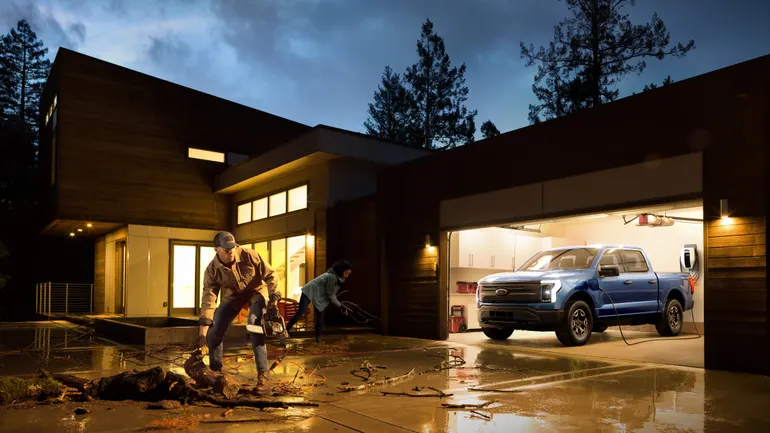
The Ford F-150 Lightning serves as a case study. Pickups tend to position themselves around utility, and the vehicle's product page dedicates significant space to features like Phone As A Key and Ford's Intelligent Backup Power options. Ford had to halt reservations on the model at 200,000 in December due to manufacturing concerns.
"Brands are treading lightly and rightly for their customers so as not to alienate them."
— David Yang, Director of innovation consulting, R/GA
Prioritizing function will likely be a common theme as OEMs emphasize qualities like driving range to a public not yet accustomed to EVs. At least in the short term, auto marketing may not undergo radical changes similar to other categories in the purpose-driven era.
"This sensitivity by the brands to play to their audiences and intended customers is a very shrewd and smart one," Yang said. "Brands are treading lightly and rightly for their customers so as not to alienate them."
That's not to say no EV brands will fly the sustainability banner. Rivian, a startup Ford retains a stake in despite a joint deal to develop EVs recently falling through, shares a lofty message on its homepage — "Preserving the natural world. Forever." — accompanied by crisp photography of mist-covered mountains. More companies will likely tout their green bona fides to shareholders as sustainability becomes a more significant means of securing investments.
Still, campaigns highlighting price, performance, and availability will lead for mass-market brands, along with efforts that lean into heritage through electrified versions of well-loved models.
"A story around value … that's traditional OEMs bread and butter," Yang said. "There's a lot of strength and equity there that they can tap into."
Obstacles Ahead
Price and brand equity will also be important wedges in the race against Tesla, which has rolled out cheaper options like the Model 3 but largely remains a premium brand.
"If everybody's in the market, and we have negated that product offering perspective, brand and all of the things that brand represents then are back on the table."
— Brian Irwin, Managing director of automotive and mobility leader, North America, Accenture
Tesla does no traditional advertising, nor does it have a public relations department. Its lead is fueled by word-of-mouth and the fervent online following of founder and CEO Elon Musk — advantages that older OEMs without a startup foothold will struggle to replicate.
"It's very hard to have a conversation about EVs presently without thinking about Tesla's outsized impact," Yang said. "While brands might not be acknowledging Tesla directly, they are certainly thinking about them behind closed doors."
In the absence of CEOs that inspire cultish devotion, legacy automakers have household brand names to lean on. Along with the F-150, familiar faces receiving EV makeovers include Mustang and Hummer — hardly lines associated with a positive environmental footprint.
"If I have a plethora of different brands all offering a [battery electric vehicle] powertrain, brand then becomes important as a defining feature," Irwin said. "If everybody's in the market, and we have negated that product offering perspective, brand and all of the things that brand represents then are back on the table."
Another obstacle to legacy automakers' EV momentum stems from the supply chain. Semiconductor shortages remain a pain point across the industry, and failures to fulfill demand could further put off consumers who have long seen EVs as failing to realize their potential.
Even as car lots remain sparse, marketers should think twice before going quiet on EV marketing, experts cautioned. Cadillac, for instance, switched its holiday playbook away from usual deals and discounts to instead prop up brand-building initiatives behind an all-electric Lyric model slated to hit dealerships in 2022's first quarter. Preorders for the SUV sold out within minutes of going live in the fall.
"What we haven't stopped is the strategic investment," Cadillac CMO Melissa Grady said during a talk addressing supply chain challenges at the Advertising Week conference in October.
That's a tack other auto brands should consider if they want to stand out in a field primed to get more competitive. At the same time, companies that do wield inventory have a chance to raise their profile if competitors can't realize production goals.
"Just because you don't have a specific model in the showroom doesn't mean that you can't advertise your brand and support that," said PHD's Murtagh. "There are always opportunities, so it might not be lower funnel, it's more upper funnel."
New Avenues to Explore
Another tactic that could see experimentation related to EVs in 2022 is the metaverse, particularly as in-person showings are imperiled by COVID-19 fears that have shaken up CES.
Hyundai last year established a virtual venue on the gaming platform Roblox designed to showcase its mobility and EV products, including the Ioniq 5 all-electric SUV. Roblox is popular with Gen Z and Gen Alpha consumers, making the theme park-like activation — the first of its kind from a global automaker — a clear bid to foster loyalty with the next generation of drivers.
While the metaverse won't become a major line item for auto brands in the near term, it's possible that 2022 will serve to further test the waters and engage a group of up-and-coming buyers more familiar with spaces like gaming and who care more about the environment.
"As younger car buyers are jumping in the market, of course EVs will be appealing. Meeting these younger potential customers where they are with respect to channels will be important," Yang said.
"Given that we're not all necessarily engaged in the metaverse at this moment, it will almost be a pragmatic way to experiment with some things so that they've got the right baseline to work with as those things actually take off," he added.
