
Heat Pumps Gain Traction, Yet Commercial Retrofits Encounter Formidable Hurdles
Heat pumps are gaining recognition across the U.S. for their efficiency and lower emissions, with a coalition of governors pledging to reach 20 million installations by 2030. However, retrofitting existing commercial buildings faces significant hurdles, including physical constraints, high costs, and grid limitations. Experts discuss strategies such as hybrid systems and demand response, while emphasizing that heat pumps are just one part of a broader decarbonization approach.
Heat pumps are increasingly recognized across the United States for their energy efficiency and reduced greenhouse gas emissions relative to other building heating and cooling options. The U.S. Climate Alliance, a bipartisan coalition of 25 governors, recently committed to increase heat pump installations across their states to reach 20 million by 2030. Currently, the U.S. has about 4.8 million heat pump installations, according to RMI, a clean energy think tank.
Adoption varies from state to state. In Massachusetts, concerns about upfront costs and the complexities of selecting appropriate equipment have slowed adoption, putting the state behind counterparts like Maine, which has already surpassed its 2025 target of 100,000 heat pumps. Maine Gov. Janet Mills recently set a more ambitious goal of reaching 175,000 heat pumps by 2027.
Facilities managers considering heat pump deployment in existing buildings have concerns about cost—despite the availability of federal incentives—as well as the significant work and disruption that retrofits can entail.
Physical Challenges
The feasibility of retrofitting existing buildings with heat pumps varies from building to building. “It’s certainly a proven technology. [But] just doing a swap-out of your HVAC system for a heat pump system may not be the best strategy,” said Ryan Colker, vice president of innovation at the International Code Council.
Kailash Viswanathan, director of energy at Arch Energy, a subsidiary of Consigli Construction, identifies two significant challenges. First, building occupancy. The ability to undertake such a major renovation is “very much occupant-driven,” Viswanathan said. “If it's a centralized plan, it's easier. But you still have to get into the building. You have to open up walls and change pipes to make it happen. [In most cases], such changes can be made only when occupants are leaving or when there's a turnover of tenants.”
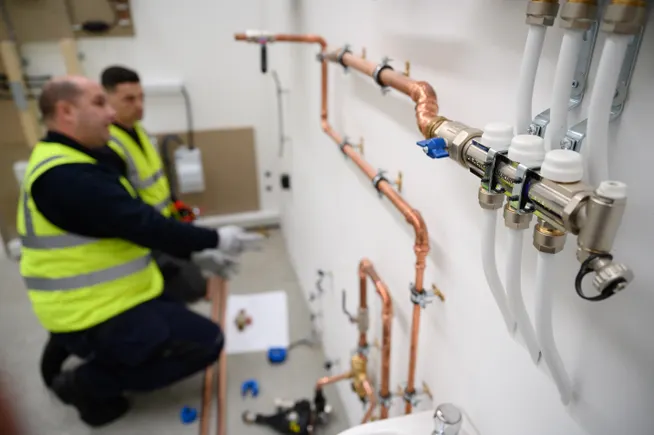
Second is maintaining space heating and water heating temperatures. Heat pumps operate most efficiently at lower water temperatures, Viswanathan noted. Retrofitting existing buildings involves reducing water temperature from 180 degrees Fahrenheit to between 120 and 140 degrees Fahrenheit. To achieve the same heat output with lower-temperature water requires a greater flow rate. “That means you need to increase the diameter of the pipes. And that involves getting into an occupant's space and removing and changing the pipes. That's disruptive,” he said. “That's why there are 10- to 12-year plans. It’s not going to happen overnight. And challenging buildings, like historic buildings, will take a longer time to retrofit—about 20 years or so.”
Viswanathan is part of a team retrofitting heat pumps into a high-rise building at 345 Hudson St. in New York City. This inaugural initiative by the New York State Energy Research and Development Authority aims to rapidly electrify one of New York City’s century-old buildings. “We help engineers [and the clients] find solutions and … figure out what the best way [is] to reduce carbon emissions in this building,” he said.
“Facilities managers are always part of the decision-making process,” he added. “They think about what challenges are involved in operating, maintaining and controlling heat pump technology better. There's a lot of automation that comes with it, and they have to learn that.”
Economic Challenges
Another significant barrier is cost. Estimates from Rosen Consulting Group suggest that the overall cost in 2022 of retrofitting a typical gas-powered office building in New York state with a ground-source heat pump ranges from $17 to $24 per square foot, while an air-source heat pump would cost from $12 to $21 per square foot. These estimates include heat pump water heaters, necessary infrastructure, and electrical upgrades. The report notes that heat pump retrofits in office buildings could yield “significant energy bill savings” over time, though those savings estimates were based on additional building shell improvements that would incur extra costs. The Inflation Reduction Act provides federal tax credits and state-administered rebates to offset purchase and installation costs.
Facilities managers need a clear understanding of the financial costs and benefits, including long-term maintenance factors, to validate their decisions, said Doug Davenport, founder and executive director of Prospect Silicon Valley, a nonprofit cleantech accelerator focused on transportation, energy, and infrastructure.
Davenport also emphasized the need for more “education and training [on] aggregating and interpreting performance outcomes from real installations to prove that the technology works as reported. [This] is going to be especially true with a wave of new designs coming to market.”
One approach to reduce retrofit costs is implementing a hybrid system. Geothermal heat pumps with hybrid heat exchange can help building owners lower capital expenses and improve economic feasibility, the National Renewable Energy Laboratory reported in September. NREL added the ability to analyze such systems to its REopt tool, which helps building managers evaluate the mix of renewable energy, conventional energy, storage, and GHP technologies to meet cost, clean energy, and resilience goals.
Potential Grid Challenges
Despite heat pumps’ immediate decarbonization benefits, at scale they can strain local power grids that may lack the generating capacity to accommodate anticipated building electrification growth. “You can’t just install heat pumps and not fix the grid. What everyone is waiting for is whether the grid is going to green itself,” said Owen Glubiak, vice president of revenue at Cortex Sustainability Intelligence.
Cortex recently launched an automation feature on its building decarbonization platform to help clients cut energy use and carbon emissions. Using heat pumps within a demand response-driven scenario can alleviate grid strain, Glubiak said. “You see the biggest problems during the warmest and coldest days. So, demand response programs are going to become very important to ensure that you are meeting peak demand.”
One Piece of the Decarbonization Puzzle
As Glubiak indicates, heat pumps alone are not the complete solution for electrification. The benefits are maximized when facilities managers adopt heat pumps as part of a full system that includes solar panels and battery storage, said Thomas A. Kwan, Schneider Electric’s sustainability research director.
When deciding whether a heat pump retrofit makes economic sense, ICC’s Colker recommends an in-depth energy audit to provide comprehensive insights into “where you’re going to get the most bang for your buck and where you’ll get the best climate change impacts.”
Facilities managers upgrading decades-old systems tend to make pragmatic decisions, said Mark Grinis, who leads digital transformation initiatives for EY Americas’ real estate practice. “If something is broken, let’s fix it properly. But do we want to entertain a very complex retrofit?” he said, describing typical thinking. The feasibility of a heat pump retrofit is also location-dependent in terms of attracting broader tenant groups and realizing higher economic returns. There may be opportunities for cool roofs and rooftop solar in older buildings, he added, but “I feel like I see heat pumps much more on new builds.”
Heat pumps currently fulfill only around 10% of worldwide heating demand in buildings, significantly short of the deployment needed to align with 2050 net zero emissions targets, according to the International Energy Agency. It calls for more policy support and technical innovation to boost energy efficiency, reduce upfront costs, and remove market barriers to complex retrofits.