
Ann Arbor Voters Approve 'Sustainable Energy Utility': What Comes Next?
Ann Arbor, Michigan, voters approved a ballot measure to create a sustainable energy utility (SEU) that will supplement DTE Energy's service, focusing on rooftop solar and battery storage. The SEU aims to boost local clean energy and resilience, with operations expected to start within two years.
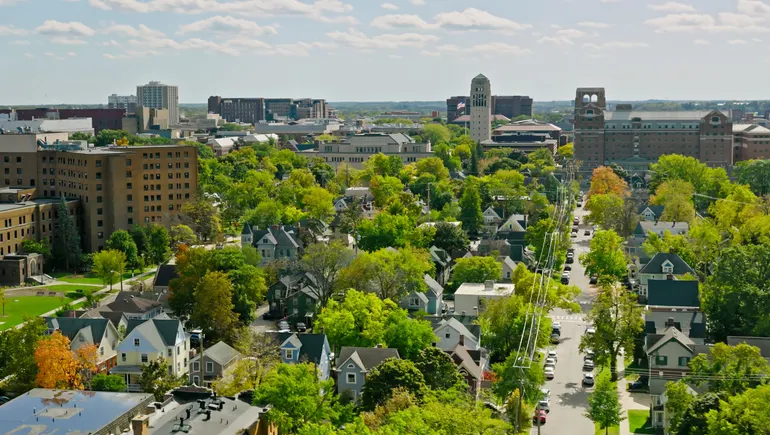
When electrical engineer Johanna Mathieu first heard about Ann Arbor, Michigan's plan to create a "sustainable energy utility" (SEU), she thought it was an unconventional idea. Despite DTE Energy, an investor-owned utility, already supplying the city's electricity, Ann Arbor intends to establish a supplemental utility that will initially concentrate on installing rooftop solar and battery storage at homes, businesses, and other institutions across the city. Over time, the plan includes developing microgrids to enable these buildings to share renewable energy across property boundaries, complementing the existing power lines.
This concept of duplicating grid infrastructure challenges the fundamental principles Mathieu teaches as an associate professor of electrical engineering and computer science at the University of Michigan. "Power grid 101 is you don't build duplicate infrastructure because it doesn't scale," she said. "That [infrastructure] should be owned and operated by a single company that's heavily regulated by a state or federal government."
However, Ann Arbor voters have decided the SEU makes sense: 79% of them voted on Nov. 5 to pass a ballot measure authorizing the city to establish, construct, operate, and own the new utility. Officials hope to begin operations within the next two years, aiming to ramp up local clean energy generation and enhance the community's electricity resilience.
How the SEU Will Operate
Initially, the SEU will cover the full upfront cost of installing rooftop solar and battery storage systems for participating customers—homes, businesses, and institutions. The SEU will own and operate these systems indefinitely, recovering its investment over time by charging customers for the energy generated, according to Missy Stults, Ann Arbor's director of sustainability and innovation.
Once enough neighboring customers sign up, the city plans to construct microgrids that allow them to share renewable energy. This infrastructure would also enable SEU customers to maintain power during outages on the main DTE grid.
The SEU will also offer programs to help customers pay for energy efficiency improvements, weatherization, and electrification. Additionally, it could operate community solar programs using solar power generated in shared city spaces and construct networked geothermal systems to heat and cool neighborhoods without on-site fossil fuel combustion.
What distinguishes the SEU from a standard municipal utility—besides its exclusive focus on local clean energy and decarbonization—is that it does not aim to fully replace the existing utility. Instead, it complements DTE, giving Ann Arbor residents more choices for their energy supply. SEU customers will receive separate bills: one from the SEU and another from DTE for the energy each provides.
As the SEU adds more locally generated clean energy, the community will likely need less power from DTE. However, a 2023 report prepared for the city indicates it's unlikely the SEU will fully replace DTE in the foreseeable future. Stults noted via email that modeling suggests the SEU could one day provide more than 75% of the community's total energy needs, but that outcome is unlikely "for a very, very long time as we'd need almost everyone in the City to sign up to meet that threshold."
 Workers install solar panels on a home’s rooftop in Washington state. Ann Arbor’s SEU would initially focus on installing rooftop solar and battery storage at homes, businesses and other institutions citywide.
RyanJLane via Getty Images
Mathieu, who now collaborates with the city as a researcher on the project, no longer views the SEU as a crazy idea. Although it may not be the most technically elegant model for energy infrastructure, she believes it is the city's best bet for rapidly scaling up clean energy. Other paths, such as pushing the existing utility to accelerate its clean energy transition or staging a municipal takeover of its infrastructure, are not realistic, she said. "I've explained this to people like, 'This is the fifth-best solution, but solutions one through four are not viable for a variety of different reasons,'" Mathieu said. "Five is feasible. So, let's do it."
Seeking More Control
The passage of the SEU ballot measure marks a key milestone in Ann Arbor's years-long effort to gain more control over its energy sources. The city's climate goals include using 100% renewable energy citywide by 2030.
Some community members have advocated for the city to buy and take over the existing utility infrastructure through municipalization, but that could take years and cost Ann Arbor upwards of $1 billion. Municipalization efforts often face strong pushback from incumbent utilities, although they can provide communities with bargaining leverage to secure concessions like lower rates or clean energy commitments.
Others in Ann Arbor have pushed for Michigan to allow local governments to participate in community choice aggregation, which would let cities purchase renewable energy on behalf of residents while the existing utility manages billing and distribution. State lawmakers have yet to pass such a law, which would likely face "strong opposition" from incumbent utilities, according to an FAQ document the city produced.
In 2021, "this idea emerged of, 'Well, could we form a supplemental utility that doesn't focus on a takeover?'" Stults said. "Because, honestly … the goal wasn't to own the system. The goal was to generate clean, reliable, affordable power."
Stults assembled a small advisory task force of experts, who determined an SEU would be technically and economically feasible as well as legal under Michigan state law.
In some respects, Ann Arbor is following the examples of Delaware and Washington, D.C., which have had versions of an SEU for years, but those differ from Ann Arbor's plan, Stults said. Delaware's SEU, for instance, is a nonprofit that offers programs to help home, business, nonprofit, and farm owners access renewable energy and make efficiency upgrades, but it does not operate microgrids, according to John Byrne, president of the Foundation for Renewable Energy and Environment and a researcher who created the model for Delaware's SEU.
How to Start an SEU
Creating a new utility involves startup costs, such as hiring a director and setting up a billing system, Stults said. To avoid burdening a small number of initial customers with these costs, the city will delay launching the SEU until its waitlist of potential subscribers reaches 20 MW of annual demand.
Meeting the 20 MW threshold could involve one or two large institutional partners or a thousand individual residents, Stults said. The city has been in discussions with the public school system and other institutions about joining, and Stults expects quite a few to do so.
The picture changes if Ann Arbor secures grant funding rather than taking on debt to finance the SEU fully. With grants, the SEU would need less demand to guarantee low rates for initial subscribers, Stults said. She is also talking with venture capitalists about investing, and the city is budgeting $250,000 to $300,000 from existing funds to hire a director.
As of Dec. 4, the waitlist, which the city began publicizing in October, had just over 650 names, Stults said, but she doesn't yet know the exact demand that represents or whether those are households, businesses, or institutions. That information collection will likely begin in 2025.
The SEU's final electricity rates will be "heavily influenced" by subscriber numbers and financing, according to the city. Stults said the SEU will likely always be able to offer lower rates than DTE, partly because it doesn't need to generate profits for shareholders and can access low-interest capital given the city's AAA municipal credit rating.
Customers can join or leave the SEU at any time, but if they leave, the city will remove its owned infrastructure from the building, Stults said. The cost of removal, along with equipment depreciation and replacement, will be built into rates.
 Ann Arbor Sustainability and Innovations Director Missy Stults speaks about the SEU in an Aug. 14, 2024, episode of Green Light, a public access TV show the city’s Office of Sustainability and Innovations produces.
Retrieved from CTN Ann Arbor.
The SEU's reliance on public buy-in is why the city put it on the Nov. 5 ballot, even though it could have proceeded without voter approval. "It's a big deal to start your own utility, even a supplemental, opt-in utility," Stults said. "This was the best way we could think of to confirm the public is seriously interested in this, even those who will never subscribe. Do they want more choice in the system?"
Stults says the SEU has not faced organized opposition, though she has encountered misperceptions about its scope. Residents favoring full municipalization say the SEU is a step in the right direction but fails to meet the urgency needed to address climate change. "[The SEU] will not be enough to reach the city's 2030 renewable energy goals, or to address our chronically unreliable power grid," Greg Woodring, president of Ann Arbor for Public Power, said in a statement.
Key to the SEU's long-term success is community ownership, said Byrne, who worked on Delaware's SEU. "The problem is, if you're inside government, is it really the community that's governing, or is it really the bureaucracy, if you will?" he asked. He suggests Ann Arbor "keep this entity close to communities."
DTE Energy, in a statement to Smart Cities Dive, said it is "dedicated to supporting the City of Ann Arbor's clean energy goals." DTE likened the SEU to its MIGreenPower program, through which customers can pay to support clean energy. "When coupled with DTE's planned investments in clean energy, these voluntary, fee-based programs help accelerate economy-wide decarbonization while maintaining reliability and affordability," DTE said.
A Model for Other Cities?
Could Ann Arbor's SEU model work elsewhere? "From an engineering standpoint? From a social, economic standpoint? Absolutely," Mathieu said. "From a legal and regulatory standpoint, I feel like it depends on the laws in that state or jurisdiction." She adds, "we can do it in one city and learn a lot and then see if it makes sense in other places. I don't think we'll have lost much by trying."
One challenge is convincing federal funding reviewers that the idea is worth backing, Mathieu said. "When we get this reviewed by other engineers who haven't been brought along to thinking about it that way, they're like 'No, this is crazy,'" she said. "We could be moving a lot faster if we can get over this barrier of people thinking, 'This is the way it's always been, [so] this is the way it always should be.'"
Byrne explained that existing "rules" for grid stability are entrenched in a traditional orientation around large central power plants, but communities could reconsider those standards in favor of a new paradigm. "If you want to have renewable energy go faster, don't build it on the same model that got you in the dilemma that you now have, which is fossil fuel and nuclear power plants that are centralized and big grids that are very costly infrastructure," he said. "Try and work on alternative infrastructures."