
Pandemic Reshapes Architectural Spaces: New Design Trends for Offices, Hotels, and Mixed-Use Complexes
The United States has entered the mass vaccination phase for COVID-19, but the construction industry will continue to deal with pandemic-driven design changes for years. Office design may return to a balance of enclosed and flexible layouts, hotels shift toward self-service and wellness amenities, and multi-family residences add flexible spaces. Contractors need to focus on air handling, antimicrobial materials, and new regulations.
As the U.S. enters the mass COVID-19 vaccination phase, the physical threat of the virus may soon be a thing of the past. However, construction industry professionals will continue to see the pandemic's imprint in their daily work for years to come—those designs and new building features intended to maintain social distancing and create safer living and working environments.
Spaces where people gather most will see the biggest changes, including offices, hotels, and multifamily housing. This article outlines the changes various building types may undergo due to pandemic mitigation strategies, as well as key information contractors need to know.
Offices: Collaboration and Flexibility Both Valued
Brad Simmons, managing partner and architect at KAI Enterprises, noted that after years of new construction and renovation projects dominated by open-plan designs, many office building owners may return to layouts with closed offices and cubicles, but with an emphasis on flexibility to accommodate possible temporary or permanent reductions in on-site staffing.
However, Lesley Braxton, architect and leader of Perkins+Will's Atlanta office, does not believe collaboration-oriented design will undergo a major shift anytime soon. "I think everyone views their home as a private office and the office as a place for collaboration," she said. "So, I don't think spaces will become more compartmentalized; they will become more open," Braxton added.
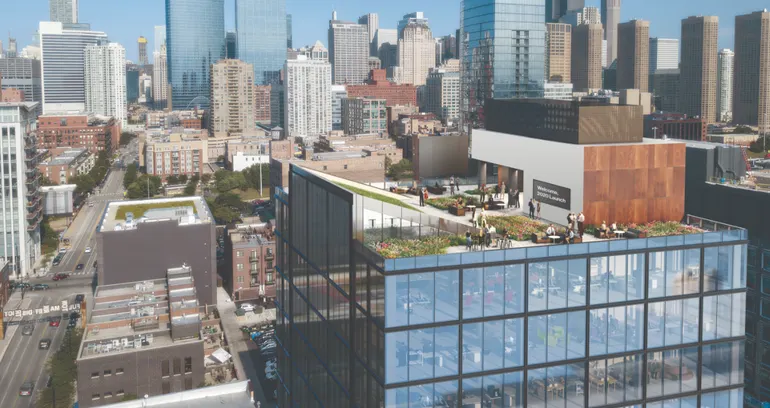
A $26 million office building in Chicago that opened this summer is among the first in the U.S. to include design features that address COVID-19 safety. The 90,000-square-foot Fulton East (pictured above) was under construction when the pandemic broke out and has now been specifically designed for maximum social distancing, touchless operation, and air and surface disinfection.
Bob Wislow, CEO of Parkside Realty, developer of Fulton East, said he foresees office design moving away from large-floor-plate buildings—the kind where each floor houses multiple companies sharing restrooms, corridors, and common areas. Meanwhile, high-rises with crowded lobbies and long elevator waits will also become less desirable.
Fulton East has only three columns per floor, allowing flexible office layouts to comply with social distancing requirements, including two separate wet-column areas that can accommodate two separated cafés and kitchens. Tenants do not share corridors and restrooms, and each restroom has one more fixture than required by Chicago city code.
Other health, safety, and wellness enhancements include: a private 9x27-foot outdoor terrace on each floor that is not shared, a touchless elevator system, and the airPHX air and surface disinfection system, which the company claims reduces viruses, bacteria, and mold on surfaces and in the air.
Hotels: Moving Toward Self-Service
My-Nga Lam, design director at Chicago's Lucien Lagrange Studio, said the pandemic has slowed hotel projects, but some developers have expressed a desire to move projects forward as residential buildings that could be used as Airbnbs, with future conversion to extended-stay hotels.
Joan Sizemore, interior design director at BKV Group, pointed out that even before the pandemic, brands like Marriott's Moxy Hotels had already shifted from traditional food and beverage services (such as made-to-order breakfast or open buffets) to secure pantries—offering sealed, ready-to-eat food—thereby eliminating the need for dedicated food preparation areas or kitchens. She believes that when designing public areas, flexibility and multifunctionality are key, while controlling necessary distances between guests by reducing and adjusting seating areas.
A recent white paper from Leo A Daly architecture firm noted that, similar to offices, hotel owners and developers will place greater emphasis on health-related amenities such as high-performance ventilation systems and antimicrobial finishes to enhance guest well-being and safety. Mark Pratt, co-author of the white paper and vice president and global hospitality leader at Leo A Daly, told Construction Dive that this health and wellness trend will bring contractors in the U.S. a significant amount of new construction and renovation work.
"Contractors can expect a large amount of immediate renovation work," Pratt said. "For example, carpet in guest rooms at full-service Marriott or Hyatt hotels needs to be replaced with hard flooring that looks and feels cleaner; removing shower curtains and replacing them with glass doors is also a common change." He suggested that hotel contractors prepare "pandemic renovation packages" for hotels of different tiers, which may cover corridor and public area flooring, replacing countertops and fixtures with antimicrobial and antibacterial finishes, and adding high-efficiency filters to HVAC systems. Materials previously used primarily in healthcare facilities and commercial kitchens—stainless steel, porcelain, solid surfaces, glass—will become common in hotels, so Pratt reminded construction firms to start sourcing suppliers for such materials now.
He also said that equipping indoor-outdoor dining or gathering spaces with air curtains for climate control will become important, even in colder regions like the Northeast. "Brands have been driving this change of blurring the lines between indoor and outdoor," Pratt said. "But we're seeing that the definition of more public spaces will include operable curtain walls that open spaces to the outdoors, bringing in more fresh air. Overall, all spaces will increase airflow and exchange, bringing in more outdoor air."
Multifamily Housing: More Spacious Units
Lam said that for the multifamily projects Legrange is currently working on, more people working from home does not necessarily mean a change in design, but rather a continuation of trends that began before the pandemic. "Residential building features that were already gaining attention before the pandemic are now becoming more of a priority." This includes home office spaces and private outdoor areas for each unit. Lam said the added space within units does not mean owners will eliminate shared amenities, but rather create flexibility to address situations where COVID-19 or other events force residents to spend more time at home.
Lam also observed that residential buildings—whether for rent or sale—are becoming less dense, with fewer units, but this trend is not entirely driven by the coronavirus; it is also a result of many properties being designed to be more "elegant." As density decreases, extra space can run through the building, providing more room for waiting areas and lobbies. However, this does not mean large projects with shared amenities like basketball courts and daycare centers will disappear anytime soon. "I think these amenities may be rethought," Lam said. As with offices, spaces will be flexible, such as large open indoor-outdoor areas that can be subdivided with partitions or modular furniture.
Other Considerations
Simmons noted that regardless of building type, certain elements may change across all buildings, such as touchless entryways and products like sensors that allow people to pass safely through lobbies, doorways, restrooms, and other interior and exterior spaces without touching too many surfaces. Braxton believes designers will reconsider the texture of chosen materials, favoring those that are easy to clean. In fact, the industry may face a copper shortage because copper has natural antimicrobial properties.
Simmons said owners are already rethinking their new and existing air handling systems, and Leo A Daly's research predicts that air handling will become a major focus of pandemic-era spaces. The study noted that several air isolation and disinfection systems used in hospitals will become more mainstream in industries like hospitality, including:
- Negative pressure air handling units
- High-performance ventilation
- Antimicrobial, antibacterial, and/or UV disinfection
- Outdoor air exchangers
Finally, Simmons said COVID-19 could impact building codes and industry guidelines, much like the Americans with Disabilities Act in the 1990s forced industry changes. The International Code Council has formed a working group to assess whether current building codes and regulations help prepare occupants and communities for disease-related threats. The working group, which includes the National Environmental Health Association, will propose modifications to reduce pandemic risks.
"The truly smart designers in the world are viewing the pandemic as an opportunity to pivot and challenge the status quo," Braxton said. "I think in the next five years, we will see more startups than ever before, and they will focus on health, wellness, and redefining what the workplace means."