
Coordinated Care: The Key to Houston's Housing First Strategy in Addressing Homelessness
Since 2012, Houston has adopted a strategy combining Housing First with coordinated care, integrating multiple resources through the unified care system "The Way Home," significantly reducing the homeless population. This article analyzes its success factors, implementation challenges, and lessons for other cities.
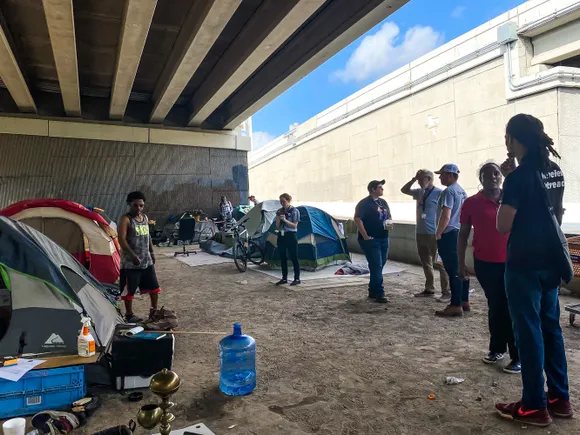
Editor's note:This article is the third in a series exploring the factors behind Houston's success in addressing homelessness and the challenges ahead.Series link。
Before 2012, the dozens of organizations serving homeless people in Houston largely did not coordinate with one another. They operated independently, implementing programs as they saw fit, described Sara Martinez, Vice President of Communications and Development at the Coalition for the Homeless of Houston.
The system changed in 2012. At that time, Houston reported a homeless population of over 7,000, and the U.S. Department of Housing and Urban Development listed it as one of the top ten priority cities. Houston held a three-day citywide meeting with over 400 attendees to discuss solutions. The meeting ultimately resulted in acitywide Housing First strategy paired with comprehensive supportive services。
The community unified its goals and actions under the shared vision of making homelessness in Houston rare, brief, and non-recurring, Martinez said in an email. To achieve this, the city and surrounding counties invested available resources as much as possible in permanent housing and supportive services.
The region also unified its system of care, naming itThe Way Home. Under HUD'sContinuum of Care program, nonprofit service providers and state and local governments receive federal funding to quickly house homeless individuals and minimize trauma.
Through The Way Home, the city, surrounding counties, and service providers work together to quickly move people from the streets into housing and provide the services they need to maintain long-term stability.
Services include outreach, housing assessments and placement, case management, healthcare, behavioral health treatment, food assistance, life skills training, and employment assistance, said Marc Eichenbaum, Special Assistant to the Mayor for Homeless Initiatives.
The Way Home system has helped reduce the homeless population in the Houston area byabout 63% since 2011. The city's strategy has become a model for other U.S. cities.
Sophie House, Director of Law and Policy at the Housing Solutions Lab at NYU's Furman Center, noted that interagency coordination and communication, as practiced in Houston, can help cities successfully implement the Housing First model and better plan for new affordable housing.
"Thinking about housing and homelessness together sounds intuitive, but in practice, agencies and experts focused on their own areas often operate in silos at the local level," House said.
Before The Way Home, Houston's homelessness system had gaps while other efforts were duplicated, Eichenbaum said. Through The Way Home's coordination, agencies doing duplicative work were asked to redirect their efforts toward filling identified service gaps.
"We wanted to align all available services to meet the specific needs of the community," Eichenbaum said.
How the system works
The Coalition for the Homeless of Houston manages The Way Home system of care. It coordinates the work of nonprofit and government agencies and centrally allocates funding from all sources, including government, individuals, grants, nonprofits like Houston Endowment, and corporations such as Wells Fargo, Chase, and Chevron, Eichenbaum said.
There are over 20 homelessness grants from various agencies, government departments, and the private sector, each with its own requirements, eligibility rules, and timelines. Integrating these funding sources to build an effective system can be overwhelming for many cities and counties, Eichenbaum said.
"The county might say: 'We have this grant, we can use it for A and B, but not C,'" Eichenbaum explained. "The city might say: 'I have that grant, I can use it for C, but not A.' So, we invest together, coordinating investments rather than acting separately, thereby leveraging each other's investments."
"That's the key to our success," Martinez said. "The Coalition figures out which funding sources can be used for which activities, blends the funds, and gets them into the hands of direct service partners so they can serve people in crisis."
ASteering Committeecomposed of officials from participating government agencies, donors, healthcare and other service providers, and individuals with lived experience of homelessness sets the goals and strategies for the system of care and works with the city and county to determine how best to utilize various funding sources, Eichenbaum said.
HUD requires each system of care to establish aCoordinated Entry Systemto assist homeless individuals. But systems vary by jurisdiction, Eichenbaum said. He noted that Houston was the first city to truly scale the system.
Benefits of coordination
Coordination of the system through which service providers and homeless individuals interact is "extremely important," said Ann Oliva, CEO of the National Alliance to End Homelessness, in an email.
When providing services, agencies need to know when people move from shelters to unsheltered locations or to soup kitchens and clinics, so they can track changes in their circumstances and find them when housing becomes available, Oliva said.
Communities should also adopt a common approach and understanding of priorities and needs, with deep communication among teams, as they may be providing different services to the same person. "This coordination enables real-time problem-solving when challenges arise," Oliva said.
Without coordination, providers often lack sufficient resources for any intervention, and people only receive available services, even if those services are not the best fit for their needs, she said.
Individuals and families also have to navigate multiple program requirements or intake processes while dealing with multiple caseworkers who do not communicate with each other, preventing coordinated care or referrals.
Homeless individuals interact with service providers through outreach coordinators at mental health facilities, shelters, soup kitchens, and on the streets, Eichenbaum said. Walking into the city's largest day shelter, one might find six assessment coordinators from different agencies working together to serve homeless people.
Eichenbaum described the numerous steps required to secure housing and other services for any individual or family. Federally funded programs require verification of applicants' income and disability status and confirmation of their homelessness. Applicants must possess specific identification. Service providers must find available housing units, help fill out applications, and seek funding for rent, supportive services, and case management.
Overall, placing one person could involve 10 different agencies and use five different grants, Eichenbaum said. Without The Way Home, both homeless clients and agencies would struggle to navigate the system and funding.
"A client's ability to get help should not depend on being at the right agency, on the right day, meeting the right person, and knowing about an eligible bed," Eichenbaum said. "So we wanted to create 'no wrong front door.'"
Challenges of coordination
The "old way" of providing homelessness programs in the community did not work, so leaders being "willing to try something different" was necessary, Martinez said. But the "major" changes to the greater Houston homelessness system "were not always smooth," for example, some service providers had to give up programs they had run for decades because they were duplicative in the new system.
Concerns and tensions have existed since The Way Home was founded. Different providers and agencies bring different experiences, services, and values, said Thao Costis, President and CEO of SEARCH Homeless Services, a member of The Way Home. Agencies have different needs and ways of doing things, want to serve different clients, and have their own goals to meet.
Working across different jurisdictions like the City of Houston and Harris County, fully aligning priorities can sometimes be challenging, especially during administrative and personnel changes, Martinez said.
Politics and local support are major obstacles for many cities that have talked with Houston about building coordinated systems of care, Eichenbaum said. How do you build coordination between local jurisdictions and the broader community? Local leaders must understand the need for coordination and recognize that no single local entity can do it alone, he said.
Moreover, a homelessness strategy championed by one mayor's administration may not be prioritized by the next. Elected local leaders often focus on other issues, so the focus on solving homelessness can fade, Eichenbaum said.
As a service provider within Houston's coordinated approach, Costis said that ultimately SEARCH has grown, serving more people with more resources, better outcomes, and stronger partnerships. The system allows, encourages, and supports providers to play to and expand their "greatest strengths."
"We buy into the overall system and goals, so we work through our differences and try to manage them to best serve our clients and community needs," Costis said. "We complement each other with our unique contributions and have created an interdependence that requires trust, communication, and bridge-building."