
Baltimore Receives $4 Million EPA Grant, Aims to Reshape Composting Development Path
The U.S. Environmental Protection Agency has awarded Baltimore City a $4 million grant to build a solar-powered composting facility at Bowley's Lane, capable of processing 12,000 tons of organic waste annually. The city is advancing organic waste collection and processing through its ten-year solid waste plan, but faces challenges such as insufficient facilities and difficulties in policy implementation.
Editor's note:For more coverage of Baltimore's 10-year solid waste plan, seeprevious articles。
Baltimore CityDraft Solid Waste Management Plan(full draft) paints an ambitious picture for organic waste collection and sorting. Now, a grant from the U.S. Environmental Protection Agency (EPA) may provide the city with much-needed momentum for change.
The grant, announcedearlier this month, will provide Baltimore with $4 million to build a solar-powered composting facility at the existing Bowley's Lane drop-off center. According to an EPAfact sheet, the facility is expected to divert 12,000 tons of organic waste from landfills annually.
Sophia Hosain, zero waste manager for the Department of Public Works, said using solar power helps the city achieve its goal of moving away from "combustion-based energy," a move intended to reduce the amount of waste sent to the WIN Waste Innovations Baltimore incinerator. The city is also seeking long-term waste disposal solutions, with its current landfill expected to reach capacity by 2035.
Hosain welcomed the EPA grant but acknowledged that more effort is needed to transform the city's organic waste management.
"We see this funding as an important first step in the right direction, but clearly, we need more local composting capacity to support our organics diversion goals," Hosain said.
In 2018, the city set goals through the Baltimore Food Waste & Recovery Strategy (Baltimore Food Waste & Recovery Strategy): reduce resident food waste by 80% by 2040 and ensure all residents have access to organic waste collection services. Meanwhile, a Maryland law passed in 2021 requires large food waste generators within 30 miles of an organics recycling facility to begin diverting organics from the waste stream.
However, despite these goals, the authors of Maryland's draft solid waste plan (expected to be approved later this year) note that the city currently "cannot easily identify the food waste generators targeted by state law." More challenging still, the city has neither a centralized organics collection program nor a large-scale facility to process such waste.
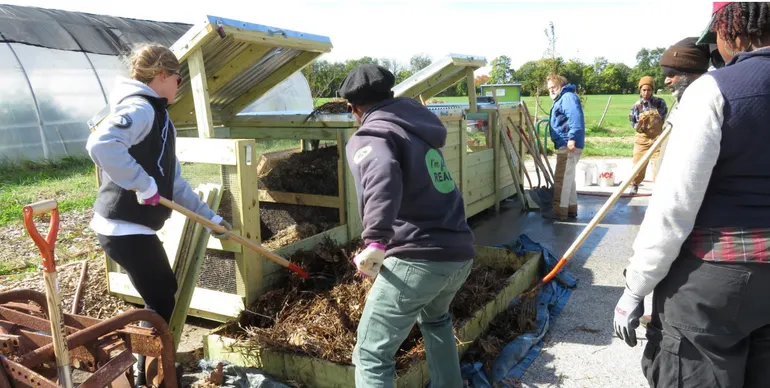
Marvin Hayes, head of the Baltimore Compost Collective, has been working to address these challenges for years. His organization composts at a small facility in the city and collects food waste from residents, but due to a lack of sufficient capacity within the city, he often has to haul excess waste to a secondary composting site in Prince George's County.
Hayes said he provided feedback to the city on the EPA grant application and called the grant a "tremendous opportunity" for the city. After years of advocacy, he believes the facility could bring more opportunities and represents a step forward for a city struggling to move toward a circular waste system.
"Baltimore taking this big step, even if it's just a mid-sized facility, has me excited right now," Hayes said. "I don't think this is a period. I think it's a comma. We can go further."
Current state of organics diversion
The city still has significant room for improvement in food and yard waste diversion—an estimated only 3.5% of organics were diverted in 2021, despite accounting for 21% of the waste stream. The organics that are diverted are primarily collected by nonprofits, community composters, and small haulers.
The lack of a centralized organics program has led some nonprofits to fill the gap. Among them, 4MyCity has gained attention for its food rescue operations and organics processing, and has received support from waste-to-energy operator WIN Waste. Christopher Dipnarine, founder of the four-year-old nonprofit, said more than 4,000 residents have already registered for its food rescue service.
Dipnarine has supported the city's grant applications in the past, but he is skeptical of the city's efforts to build composting capacity. He noted that the draft is not Baltimore's first time setting high goals for organics diversion policy.
"This isn't their first attempt," Dipnarine said, noting that 4MyCity grew without city support. "Who can guarantee they'll succeed this time?"

4MyCity has enrolled households from its food rescue service in a program that collects their food waste and provides it to farm composters or processes it using the nonprofit'sproprietary aerobic digestion technology. But Dipnarine said 4MyCity's organics processing work accounts for about "30%" of its day-to-day operations.
"The core philosophy is getting food to the community, thereby reducing food waste at the source," Dipnarine said.
So far, this echoes the city's own organics priorities. Since 2016, Baltimore hasbeen running food waste awareness campaigns, culminating in 2018 with two documents: the Office of Sustainability's Baltimore Food Waste & Recovery Strategy and the Department of Public Works' Less Waste, Better Baltimore (Less Waste, Better Baltimore). The former focuses specifically on food waste, while the latter covers broader strategies to improve solid waste and recycling.
The early strategy set ambitious organics recycling visions—beyond striving for an 80% reduction in food waste, it also set a goal of reducing commercial food waste by 50%, diverting more than 85,000 tons of organics annually. But the Less Waste, Better Baltimore plan, developed by consulting firm Geosyntec, noted that without external help, the city could dorelatively little, and so far, the city's efforts have focused primarily on promoting food recovery and educational outreach.
This year's draft still sets a timeline for launching a more ambitious and comprehensive city-supported organics collection network, and supports policies that would create demand for such infrastructure. The draft supports banning the landfill disposal of commercial organics in the city, as well as a comprehensive ban on landfilling organic materials.
According to the draft, Baltimore currently operates five food scrap drop-off sites across the city and plans to open five more this year. Between 2024 and 2028, it plans to pilot source-separated organics collection at public schools and government offices. Between 2029 and 2033, the city will expand collection of source-separated organics from residents by establishing a three-bin pilot program.
Hayes, who founded the Baltimore Compost Collective in 2017, said he diverts 1,500 pounds of organic waste weekly,collecting organics directly from residents, and relies partly on volunteer labor. He said he is near capacity and could expand further with city support. If the city follows through on its goal of rolling out source-separated organics collection to all residents by 2033, he believes he can play a larger role in the circular ecosystem.
"With city support, we could do curbside composting, we could donate, reuse, and recycle some garbage trucks" for organic material collection, Hayes said. "My goal is: to be a hauler for those businesses that must divert organic materials."

Hayes not only supports the city's plans to build more infrastructure, but he also believes education is crucial for teaching residents how to compost and why it benefits them. Hayes has worked with the city's Food Matters Program, which primarily provides education and training on organics diversion to the public and organizations, including supporting a network of community composting sites. The program launched in 2018 with support from the Natural Resources Defense Council and the Rockefeller Foundation.
Hayes continues to participate in education and training provided by the Department of Public Works at itsGROW Center. He hopes the city will also consider sponsoring youth training programs in the future to provide a pipeline of jobs and talent for the circular organics economy.
"Years ago, we never thought we could stop people from smoking indoors. But what did we do? We launched awareness campaigns," Hayes said. "Composting isn't accessible to everyone. So we need to educate them."
Organics processing plans
Baltimore's draft also plans additional processing capacity for all the source-separated organics it expects to collect.
These plans begin with a small composting training facility with a processing capacity of 3 tons per week. The facility is expected to open by 2028, with construction costs of approximately $350,000. The Bureau of Solid Waste envisions training composting professionals at the facility, who can then support existing community composting efforts.
During the planning period, the Bureau of Solid Waste also anticipates building at least one (possibly more) covered aerated static pile composting facility capable of processing 20,000 tons of feedstock annually, at a cost of $3.5 million each. The plan favors a public-private partnership model for developing such facilities, with the city providing land leases and partially guaranteed waste streams, while a third party builds and operates the composting facility. The Bureau estimates the first such facility could be operational in 2028.
Brenda Platt, co-director of the Institute for Local Self-Reliance, praised the plan for its decentralized, incremental approach to composting, contrasting it with cities like New York that increasingly rely on wastewater treatment plant co-digestion or large industrial facilities to process waste.
"Building some mid-sized facilities within the city, complementing community composting, schools, urban farms, and community gardens, could be very effective," Platt said. "The city has a tremendous opportunity to support a committed, community-driven process."
According to the Baltimore Sunreport, construction of the Bowley's Lane composting facility may not begin until 2025. Meanwhile, Baltimore has also applied for an EPA recycling education and outreach grant to fund its composting training facility. A Department of Public Works spokesperson said the city expects to build such a facility at the Quarantine Road landfill (which is planned for expansion).
Platt supports building new composting facilities, but she believes the greatest benefit of Baltimore's plan may lie in establishing infrastructure that allows a network of community composting sites to thrive.
"The plan looks very strong in supporting local composting efforts," Platt said. "We have been strong supporters and would be very happy to work with [the Department of Public Works] to advance composting in the city and address Baltimore's unique challenges."