
As Urban Centers Declare Climate and Affordability Emergencies, Do Proclamations Translate into Policy?
Hoboken, New Jersey, became the first U.S. city to declare a climate emergency in 2017, prompting a climate action plan and renewable energy initiatives. Similar declarations on racism, housing, and affordability have emerged in Evanston, Milwaukee County, New York City, Portland, and Miami-Dade County. Experts and officials debate whether these proclamations catalyze real change or serve as public relations tools, with outcomes depending on follow-through, funding, and political will.
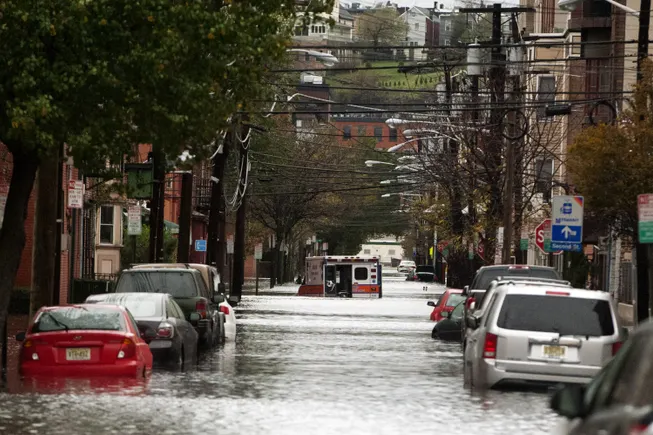
Hoboken, New Jersey, has long confronted the realities of global warming. Situated along the Hudson River within the New York metropolitan area, this coastal city faces intensifying rainfall. Following Hurricane Sandy in 2012, Hoboken secured a federal grant to construct a levee.
In 2017, Hoboken became the first U.S. city to formally declare a climate emergency, a move that signaled a shift from mere adaptation toward proactive mitigation.
“We declared this emergency as a recognition that we've been adapting to the effects of climate change for so long – since, I would argue, probably about 2010,” said Jen Gonzalez, Hoboken’s director of environmental services and chief sustainability officer. “But we then realized we need to go beyond adaptation and look at mitigating our contribution to climate change.”
Gonzalez explained that the city is now working to reduce its greenhouse gas emissions to lessen the adaptation burden anticipated in the future.
Hoboken is among a growing number of municipalities that have issued formal declarations in recent years to address persistent societal, economic, and environmental challenges. The city council in Evanston, Illinois, recently approved a climate emergency resolution. Milwaukee County, Wisconsin, and New York City both passed declarations labeling racism as a public health crisis. Portland, Oregon, and Miami-Dade County, Florida, have announced emergencies tied to housing and affordability.
Whether these proclamations serve as substantive catalysts or mere public relations exercises depends largely on local government commitment and subsequent implementation.
Climate Change as a Policy Priority
Hoboken’s declaration propelled the city to develop a climate action plan and conduct a greenhouse gas emissions inventory, completing both tasks two years after the declaration. Gonzalez noted that the inventory identified residential and commercial energy consumption as the combined highest source of emissions, prompting steps toward renewable energy supply.
Measures have included transitioning municipal facilities to 100% renewable electricity, launching a resident program that powers homes with 10% more renewable energy than state requirements, and offering homeowners the option to select up to 100% renewable electricity. The city also introduced a community solar program enabling low- and moderate-income residents at the Hoboken Housing Authority to access solar energy from a rooftop installation on a nearby warehouse.
“Having a climate resolution on the record shows that city leadership values climate action,” Gonzalez said. “This is something that we're committed to putting resources [to].”

Many cities have followed Hoboken’s example, enacting their own climate declarations. In Minnesota, more than a dozen cities have banded together through the Minnesota Cities Climate Caucus, formed to share policy best practices and amplify local influence at the state level.
Larry Kraft, who organized the caucus and serves as councilmember at large in St. Louis Park, a Minneapolis suburb, recalled recent extreme weather events including drought, rising temperatures, and summer days when wildfire smoke kept residents indoors.
“There's many individual cities doing it,” Kraft said. “But if we all did it together or many of us did it at the same time, we'd have a bigger impact both within our own communities to spur additional action and visibility, but also in terms of the goal of having more influence at the state level.”
Earlier this year, 18 Minnesota cities plus one county signed onto the declaration, according to Kraft. The group includes both rural and suburban municipalities, helping bridge the urban-rural divide.
While the resolution template offers cities suggested actions tailored to community needs, it carries no formal enforcement powers. Kraft noted that a binding declaration involving so many cities would have required more time and reduced flexibility for city-specific customization.
A key goal of the declaration is securing additional state funding and technical support, particularly for smaller cities lacking a dedicated sustainability manager.
St. Louis Park has launched several initiatives, including extra incentives for solar installations, which have boosted community solar capacity. Residents also benefit from a home energy audit program delivered by the nonprofit Center for Energy and Environment, where professionals seal doors, replace lightbulbs, install low-flow showerheads, and generate energy reports. The service costs between $35 and $50, subsidized by the city.
Kraft said commercial uses account for about 60% of emissions in St. Louis Park, so another program offers businesses free energy audits.
Government declarations on climate are not new; the Kyoto Protocol of 1997 was an international agreement to reduce greenhouse gases. However, Rushad Nanavatty, managing director of urban transformation at the Rocky Mountain Institute, argues the current context differs. Unlike past political movements that drove declarations such as Kyoto, today’s declarations stem from people directly experiencing climate impacts like heatwaves and flooding.
“It's all very, very in your face right now. And I think that's the one thing that maybe distinguishes this from past moments where you've seen kind of a surge in declarations,” Nanavatty said. “It's been tied to the fact that cities, communities everywhere in the world are now seeing and feeling the impacts very, very directly. Climate change is no longer an abstraction really to anyone.”
Declarations are necessary to signal leadership commitment and give city workers a mandate for change, Nanavatty said, but translating those commitments into concrete action is more challenging. The mayor or city council issues the declaration, yet execution often falls to energy managers, public works departments, or other agencies.
For instance, a public works department resurfacing roads might typically choose the lowest-cost asphalt. With climate as a priority, Nanavatty said the department would more likely select materials that reduce urban heat island effects or improve stormwater management. However, after a major declaration, city staff often face limited funding and technical expertise.
“The leadership declaration matters because it kind of helps rally the troops. It signals to each one of these departments within a city that this is a priority,” Nanavatty said. “But that's not the same as actually embedding climate logic.”
Holding Cities Accountable for Housing Goals
San Diego has the fifth largest population of homeless people in the U.S. The city declared an ongoing shelter crisis in 2017, again in 2019, and yet again earlier this year, allowing the government to suspend certain housing, health, and safety laws to create more shelter for unhoused residents.
But San Diego’s city council president views the declaration not as a solution but as a harm-mitigation measure.
“It's a public policy failure that we need a declaration like this in order to respond to a shelter crisis,” said Sean Elo-Rivera. “Multiple things have to have gone wrong from a public health policy perspective, from a societal perspective that leaves us in a position where the best thing that we can do in the moment is radically cut red tape to create shelter opportunities.”
The declaration enabled San Diego to quickly convert Golden Hall, a convention center adjacent to city hall, into a shelter, Elo-Rivera said. It also increased city-funded shelter capacity; compared to 2017, the number of beds has nearly tripled to 1,468 beds, according to city data.
Elo-Rivera emphasized that the declaration provides a benchmark for resident accountability. “When a city takes action and puts its name on something, it creates a different level of accountability,” he said. “If we are not making sufficient progress, specifically with shelter, I think this does provide [residents and advocates] a tool to say, 'Look, you've put your name on this. You declared a shelter crisis. Why are you not taking more definitive action to address that crisis?'”
Maxwell Palmer, associate professor of political science at Boston University, said a declaration can draw attention to issues like housing and signal to activists that their concerns are being taken seriously. Yet whether it yields more than short-term media coverage depends on the city’s subsequent actions.
“Mayors give speeches all the time with policies and priorities,” Palmer said. “But going from talk to action is complicated, and there's a lot of barriers in the way. And I'm not sure if a declaration is any different than any other kinds of speech.”
How Declarations Can Go Beyond Conversation Starters
To ensure declarations produce tangible outcomes, cities must follow through with concrete measures. Kraft said the Minnesota Cities Climate Caucus continues to meet monthly and track progress. He is hopeful the state will pay more attention; a state bill, if passed, would provide $5 million in grants for cities’ climate action plans. Additionally, heads of several state-level committees have attended caucus meetings, a development Kraft attributes to the declaration.
“It's not a one-and-done kind of thing,” he said. “You have to understand why you're doing it and keep focused on it and follow up.”
City leaders also need to communicate accomplishments to residents, Elo-Rivera said. Gonzalez from Hoboken stressed the importance of community engagement; for example, a flood mitigation project’s design changed after residents raised concerns about blocked waterfront views.
Nanavatty said governments must be willing to expend real political capital on substantive action that faces opposition. “Very few people are going to object to a high-level declaration on the importance of climate action,” he said. But reforming zoning policy, ending highway expansions, giving more street space to public transit, and calling out poor utility planning decisions often anger many people and industries.
“Those are the kind of things that will result in a really, really big impact and require a hell of a lot more political courage and political capital than the declaration.”